plants
Honey Production and Bee Management
Keep bees and produce honey: bee biology, hive equipment and types, starting a colony, the seasonal management calendar, and harvesting.
Content Extraction Summary
Hook Options
A single colony visits over two million flowers to produce one pound of honey — and every forager dies within six weeks of starting field work, her wings literally worn to failure. Honey is the only food that never spoils: archaeologists have found 3,000-year-old Egyptian tomb honey that was still edible, preserved by its low moisture, high acidity, and enzymatic hydrogen peroxide production. Varroa destructor mites are the single largest driver of colony loss worldwide, yet most new beekeepers treat them as optional — a miscalculation that kills more hives than every other threat combined.
Key Mechanism
Honey production is a dehydration and enzymatic conversion process. Forager bees collect dilute nectar (60-80% water) and pass it mouth-to-mouth among house bees, each adding invertase enzyme that cleaves sucrose into glucose and fructose. Bees then fan the processed nectar with their wings until moisture drops below 18.6%, at which point they cap the cell with wax. The low water activity, acidic pH (3.2-4.5), and continuous low-level hydrogen peroxide generation from glucose oxidase make the finished product inhospitable to microbial growth indefinitely.
Misconception to Correct
Treatment-free beekeeping sounds principled but ignores the fact that Varroa destructor is an invasive parasite with no evolutionary pressure selecting for resistance in European honey bee populations. Colonies that survive without treatment are rare genetic outliers. For most beekeepers, skipping Varroa management is not a philosophy — it is neglect that spreads mite loads to neighboring colonies.
Practical Application
Monitor Varroa loads monthly using an alcohol wash (300 bees from the brood nest in 70% isopropyl alcohol, shake for 60 seconds, count mites through a mesh lid). Treat when mite loads exceed 2-3 mites per 100 bees. Organic treatments — oxalic acid vaporization (winter) and formic acid strips (late summer) — are effective without contaminating wax or honey.
Citation-Ready Claims
- [Two million flower visits per pound of honey] -> [USDA honey bee biology fact sheet] -> [forager energy expenditure and nectar concentration data]
- [Honey's indefinite preservation] -> [low water activity + acidic pH + enzymatic H2O2] -> [Molan, 1992, *Bee World*; Cavia et al., 2002]
- [Varroa destructor as primary driver of colony loss] -> [Bee Informed Partnership annual survey data, 2010-2024]
Introduction and History
Humans have robbed bee colonies for at least 8,000 years. A Mesolithic rock painting in Valencia, Spain shows a figure climbing a rope ladder to reach a wild hive — the earliest known depiction of honey hunting. For most of that history, harvesting honey meant destroying the colony. The invention of the movable-frame hive by Lorenzo Langstroth in 1851 changed beekeeping from extraction to management. Langstroth discovered bee space — the 3/8-inch (9.5 mm) gap that bees neither fill with comb nor seal with propolis — and built a hive around it. That single observation made non-destructive inspection and selective harvest possible.
Modern beekeeping sits at a crossroads. Colony losses in the United States average 30-40% annually (Bee Informed Partnership, 2023). The causes stack: Varroa mites vectoring viruses, pesticide exposure, nutritional stress from monoculture landscapes, and management errors. Against that backdrop, small-scale beekeeping is growing. The practice integrates directly with food production, pollination, and land stewardship.
Texas is the sixth-largest honey-producing state. The Hill Country, Blackland Prairie, and Gulf Coast provide strong nectar flows — horsemint, huajillo, tallow tree, mesquite, and wildflowers. Texas also has year-round management demands: no true dormancy, Africanized genetics in feral populations south of I-10, and small hive beetle pressure in humid coastal areas.
Bee Biology
Colony Structure
A honey bee colony is a superorganism. Three castes divide labor absolutely.
**Queen.** One per colony. Her sole function is reproduction — she lays up to 2,000 eggs per day at peak season. She mates once during a mating flight in her first two weeks of life, storing 5-7 million sperm in her spermatheca. That stored sperm supplies her entire productive life of 2-5 years. She controls colony cohesion through queen mandibular pheromone (QMP), which suppresses worker ovary development and signals colony stability.
**Workers.** All female, 20,000-60,000 per colony depending on season. Workers progress through age-based roles: cell cleaning (days 1-2), nurse bee feeding larvae (days 3-11), wax production and comb building (days 12-17), guard duty (days 18-21), and foraging (days 22 until death at approximately day 42 in summer). Winter bees live 4-6 months due to elevated vitellogenin protein reserves.
**Drones.** Male bees, several hundred per colony in spring and summer. Their only purpose is mating with virgin queens from other colonies. They contribute no labor. The colony evicts them in autumn.
Communication
Foragers communicate food source locations through the waggle dance — a figure-eight movement on the comb face. The angle of the waggle run relative to vertical indicates direction relative to the sun. Duration of the waggle phase indicates distance. Karl von Frisch decoded this in the 1940s and received a Nobel Prize for it.
Lifecycle
Egg to adult takes 16 days for queens, 21 days for workers, and 24 days for drones. This timing matters for Varroa management: mites reproduce inside capped brood cells, preferring drone brood because of its longer capping period.
Equipment and Hive Types
Langstroth Hive
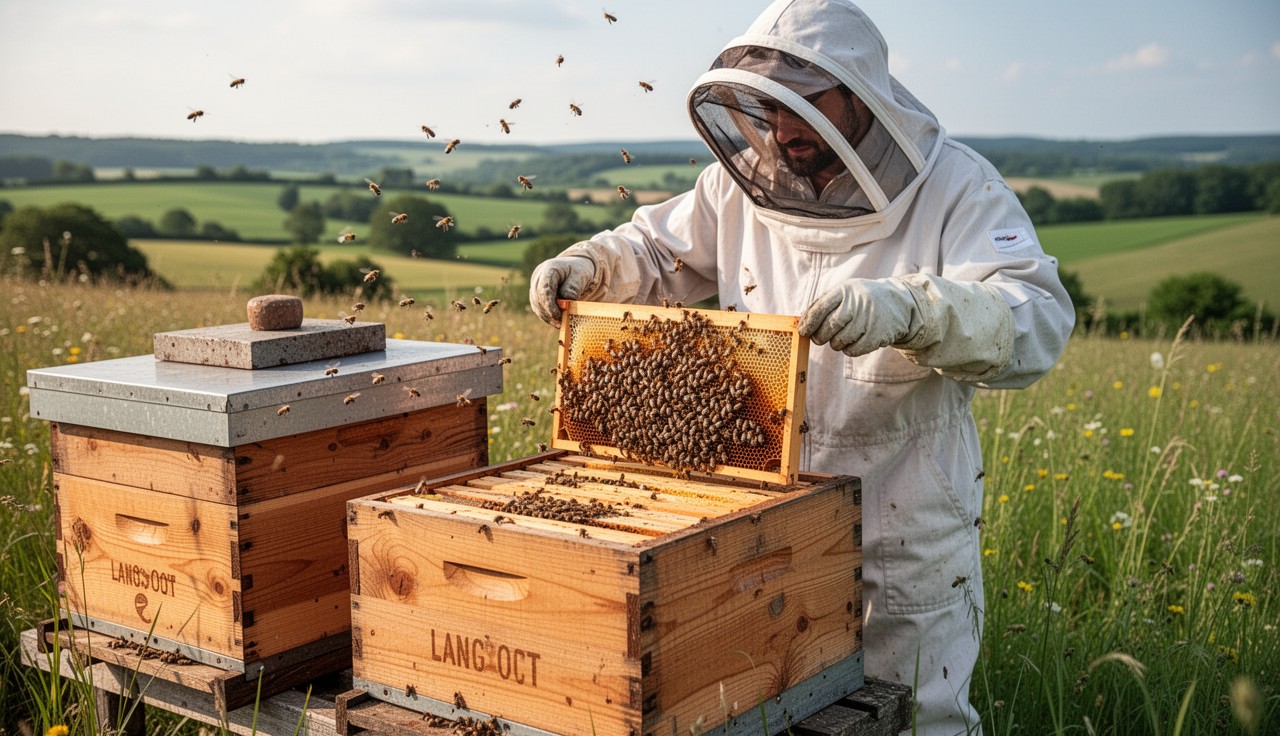
The global standard. Vertically stacked rectangular boxes with removable frames hung on standardized bee space. Available in three depths: deep (9-5/8"), medium (6-5/8"), and shallow (5-11/16"). Advantages: interchangeable parts, efficient honey extraction with centrifugal extractor (frames returned to bees intact), massive community knowledge base, and commercial equipment availability. Disadvantage: heavier boxes (a full deep can weigh 80+ lbs), requires extractor equipment.
Standard startup: two deep brood boxes, two medium honey supers, queen excluder, bottom board (screened preferred), inner cover, telescoping outer cover, entrance reducer.
Top-Bar Hive
Horizontal design. Bars rest across the top of a trapezoidal trough. Bees build natural comb downward from each bar. Advantages: no heavy lifting (bars removed individually), lower startup cost, bees build natural cell sizes. Disadvantages: comb is fragile and cannot be extracted by centrifuge (crush-and-strain only), harder to inspect without damaging comb, less honey yield per colony.
Best for: small-scale or backyard beekeepers who prioritize simplicity over production volume.
Warre Hive
Vertical like Langstroth but managed from the bottom — new boxes are added underneath (nadiring) rather than on top (supering). Designed to mimic natural cavity proportions. Minimal intervention philosophy. Disadvantage: inspection is difficult without modification, which conflicts with most state inspection laws.
Essential Tools
Smoker (calms guard bees by masking alarm pheromone), hive tool (pry frames apart), bee suit or jacket with veil, leather or nitrile gloves. A frame grip and bee brush are useful but not essential.
Starting a Colony
Three acquisition methods, ranked by reliability:
**Nucleus colony (nuc).** Five frames of drawn comb with brood, honey, pollen, and a mated laying queen. This is the best option for beginners. The colony has a functioning brood nest and can build up quickly. Cost: $150-$250 (2024 Texas pricing). Order by January for April-May delivery.
**Package bees.** Three pounds of bees (approximately 10,000) with a separately caged queen. Cheaper than nucs ($120-$180) but riskier — the queen is unrelated to the workers and must be accepted. Queen rejection rates run 5-15%. Packages lack drawn comb and brood, so colony buildup is slower.
**Swarm capture.** Free bees, but unpredictable genetics and timing. Swarms are generally docile (gorged on honey, no brood to defend). In Texas, feral swarms south of I-10 carry Africanized genetics — more defensive, smaller clusters, higher absconding rates. Requeen with known stock if temperament is aggressive.
**Installation timing.** Texas: mid-March through April, timed to spring nectar flows. The colony needs 6-8 weeks of buildup before major honey flows begin.
Seasonal Management Calendar
Spring (February-April in Texas)
Inspect colonies on the first warm day above 60 F. Check for queen presence (look for eggs — small white rods standing upright in cell bottoms). Reverse brood boxes if the cluster has moved to the upper box. Feed 1:1 sugar syrup if stores are light. Add honey supers when 70-80% of frames show drawn comb and bees are bringing in nectar. This is peak swarm season: watch for queen cells (peanut-shaped structures on frame bottoms), crowded brood nests, and congested entrances.
Summer (May-August)
Primary honey flow in Texas: May through mid-July. Add supers as needed — never let bees run out of storage space or they will swarm. Monitor water sources; bees consume up to a gallon per day per colony in Texas heat. Provide shade or ventilation for hives in full sun. Perform Varroa mite counts monthly starting in June.
Fall (September-November)
Harvest surplus honey only — leave a minimum of 60 lbs (one full deep super) for winter stores in central Texas, 40 lbs in south Texas. Treat for Varroa mites in late August or September before winter bees are produced. Feed 2:1 sugar syrup to colonies with insufficient stores. Reduce entrances to prevent robbing by other colonies or wasps. Combine weak colonies with strong ones using the newspaper method.
Winter (December-January)
Minimal intervention. Do not open hives below 50 F. Check hive weight by hefting the back — a light hive needs emergency fondant or dry sugar feeding. Ensure ventilation: moisture kills more colonies in winter than cold. Tilt hives slightly forward or use a moisture quilt box. In most of Texas, bees remain semi-active year-round.
Honey Harvest and Processing
When to Harvest
Harvest only fully capped frames. Capped cells indicate moisture content below 18.6% — the threshold for stable preservation. Uncapped honey ferments. Test with a refractometer if unsure; target 17-18% moisture.
Extraction Methods
**Centrifugal extraction (Langstroth).** Uncap frames with a heated knife or capping scratcher. Place frames in a radial or tangential extractor and spin. Honey is flung against the drum wall, flows down, and exits through a gate valve at the bottom. Strain through a double sieve (600 micron over 200 micron) to remove wax particles. This method preserves drawn comb — returned frames give the colony a significant head start on the next flow.
**Crush and strain (top-bar, cut comb).** Cut comb from bars, crush in a bucket, and let gravity strain through mesh. Slower, yields beeswax as a co-product, but destroys comb (bees must rebuild from scratch, costing approximately 8 lbs of honey per 1 lb of wax produced).
Post-Processing
Let extracted honey settle in a bottling bucket for 24-48 hours. Air bubbles and fine debris rise to the surface. Skim and bottle. Do not heat above 95 F (35 C) — heat degrades enzymes (diastase, invertase), darkens color, and increases hydroxymethylfurfural (HMF). Raw, unheated honey retains the enzymatic activity and pollen profile that define quality.
Yield Expectations
A healthy colony in good Texas forage can produce 30-60 lbs of surplus honey per year. First-year colonies rarely produce surplus — they are building comb and population. Expect harvest starting in year two.
Beeswax and Other Hive Products
**Beeswax.** Rendered from cappings and old comb. Melt in a solar wax melter or double boiler (never direct heat — wax is flammable). Filter through cheesecloth. Uses: candles, salves, food wraps, leather conditioning, wood finish. Market value: $12-$20/lb retail.
**Propolis.** Resinous substance bees collect from tree buds and use to seal cracks and sterilize the hive. Antimicrobial properties documented in peer-reviewed literature (Sforcin, 2007). Harvested with propolis traps (flexible plastic grids placed above frames). Tincture in 95% ethanol for 2-4 weeks, strain.
**Pollen.** Collected with pollen traps at the hive entrance (bees pass through a mesh that scrapes pollen loads from their legs). Freeze immediately — fresh pollen spoils within 24 hours at room temperature. Pollen trapping reduces colony nutrition; use intermittently, never continuously.
**Bee bread.** Pollen fermented in the comb with honey and enzymes. Higher bioavailability than raw pollen. Difficult to harvest without destroying comb; small-scale only.
Common Diseases and Pests
Varroa destructor
The single greatest threat to managed honey bees worldwide. An external parasitic mite that feeds on fat body tissue (not hemolymph as previously believed — Ramsey et al., 2019). Vectors at least five viruses, most critically deformed wing virus (DWV). Without management, a colony typically collapses within 1-3 years.
**Monitoring.** Alcohol wash: scoop 300 bees (~1/2 cup) from a brood frame into a jar with 70% isopropyl alcohol. Shake vigorously for 60 seconds. Pour through a mesh strainer into a white basin. Count mites. Threshold: treat at 2-3 mites per 100 bees (2-3%).
**Treatment options (organic approved):**
- Oxalic acid vaporization: 1g sublimated into the hive during broodless periods. Highly effective, minimal residue.
- Formic acid (Formic Pro strips): penetrates cappings, kills mites in brood cells. Use when daytime temps are 50-85 F.
- Thymol-based treatments (Apiguard): gel applied above frames, effective at 60-105 F.
**Synthetic options (resistance risk):** Amitraz (Apivar strips), tau-fluvalinate (Apistan). Rotate chemistries to slow resistance development.
American Foulbrood (AFB)
Bacterial spore disease (*Paenibacillus larvae*). Fatal to larvae; spores persist for 50+ years in equipment. Ropy brood test: insert a matchstick into a sunken, discolored cell cap — if contents string out 1+ inch, suspect AFB. Reportable disease in most states. Infected equipment must be burned. There is no cure for contaminated comb.
Small Hive Beetle (SHB)
*Aethina tumida.* Major problem in humid climates — Gulf Coast Texas is high-risk. Adult beetles lay eggs in cracks; larvae burrow through comb, fermenting honey and ruining frames. Management: maintain strong colonies (bees patrol and corral beetles), use oil traps on bottom boards, avoid storing wet supers in warm humid conditions.
Nosema
Microsporidian gut parasite (*Nosema ceranae*). Causes dysentery and reduced lifespan. Diagnose by spore count under 400x microscope. Fumagillin was the standard treatment but is no longer available in many markets. Strong nutrition and good ventilation are the primary management tools.
Overwintering
Texas beekeeping has a milder overwintering challenge than northern states, but colony losses still run 25-35%.
**Key principles:**
- Ensure adequate stores: 60 lbs minimum in central Texas, more in the Panhandle.
- Reduce entrances to keep out mice and cold drafts.
- Ensure upper ventilation to prevent condensation dripping onto the cluster. A moisture quilt box (burlap-topped box filled with wood shavings above the inner cover) works well.
- Do not wrap hives in Texas — overheating is a greater risk than cold.
- Treat for Varroa before October. Winter bees produced in September-November must be healthy; mite-damaged winter bees mean spring deadouts.
- Requeen colonies with failing queens in early fall. A young queen going into winter produces a stronger spring buildup.
Integration with Garden and Farm Systems
Honey bees are generalist pollinators that increase yield on most fruit, vegetable, and seed crops. Place hives within 1/4 mile of target crops for maximum foraging efficiency.
**Orchard integration.** Two colonies per acre of tree fruit is the standard pollination stocking rate. Avoid spraying insecticides during bloom — even organic-approved pyrethrins and spinosad are lethal to bees on contact.
**Cover crops for forage.** Plant bee-attractive cover crops to extend the nectar dearth periods: crimson clover (spring), buckwheat (summer), and autumn-blooming asters and goldenrod. In Texas, native horsemint (*Monarda citriodora*) is a prolific nectar source that reseeds freely.
**Water.** Provide a reliable water source within 50 feet of the apiary. Bees prefer slightly dirty water with mineral content — a dripping faucet onto a bed of gravel or a shallow dish with pebbles works. If you do not provide water, they will find your neighbor's pool.
**Apiary placement.** Face hive entrances south or southeast. Provide morning sun and afternoon shade in hot climates. Elevate hives on stands to deter skunks and improve air circulation. Maintain at least 3 feet between hives. Keep a clear flight path — do not place hives facing a walkway or property line within 25 feet.
References
1. Langstroth, L. L. (1853). *The Hive and the Honey-Bee.* Northampton, MA. 2. Seeley, T. D. (2010). *Honeybee Democracy.* Princeton University Press. 3. Molan, P. C. (1992). The antibacterial activity of honey. *Bee World*, 73(1), 5-28. 4. Ramsey, S. D. et al. (2019). Varroa destructor feeds primarily on honey bee fat body tissue and not hemolymph. *Proceedings of the National Academy of Sciences*, 116(5), 1792-1801. 5. Sforcin, J. M. (2007). Propolis and the immune system: a review. *Journal of Ethnopharmacology*, 113(1), 1-14. 6. Cavia, M. M. et al. (2002). Evolution of quality parameters of honey. *Food Chemistry*, 78, 329-338. 7. Bee Informed Partnership. (2023). Annual Colony Loss Survey Results. https://beeinformed.org 8. Delaplane, K. S. & Mayer, D. F. (2000). *Crop Pollination by Bees.* CABI Publishing. 9. Spivak, M. & Reuter, G. S. (2001). Varroa destructor infestation in untreated honey bee colonies. *Journal of Apicultural Research*, 40(4), 169-176. 10. USDA-NASS. (2023). Honey Production Report. United States Department of Agriculture.
Tags: `[beekeeping]` `[honey]` `[practical-skills]` `[livestock]` `[farm-systems]` `[beginner]` `[texas]`