guides
Candle Making
Complete practical guide covering combustion science, wax selection, wick sizing, container and pillar candles.
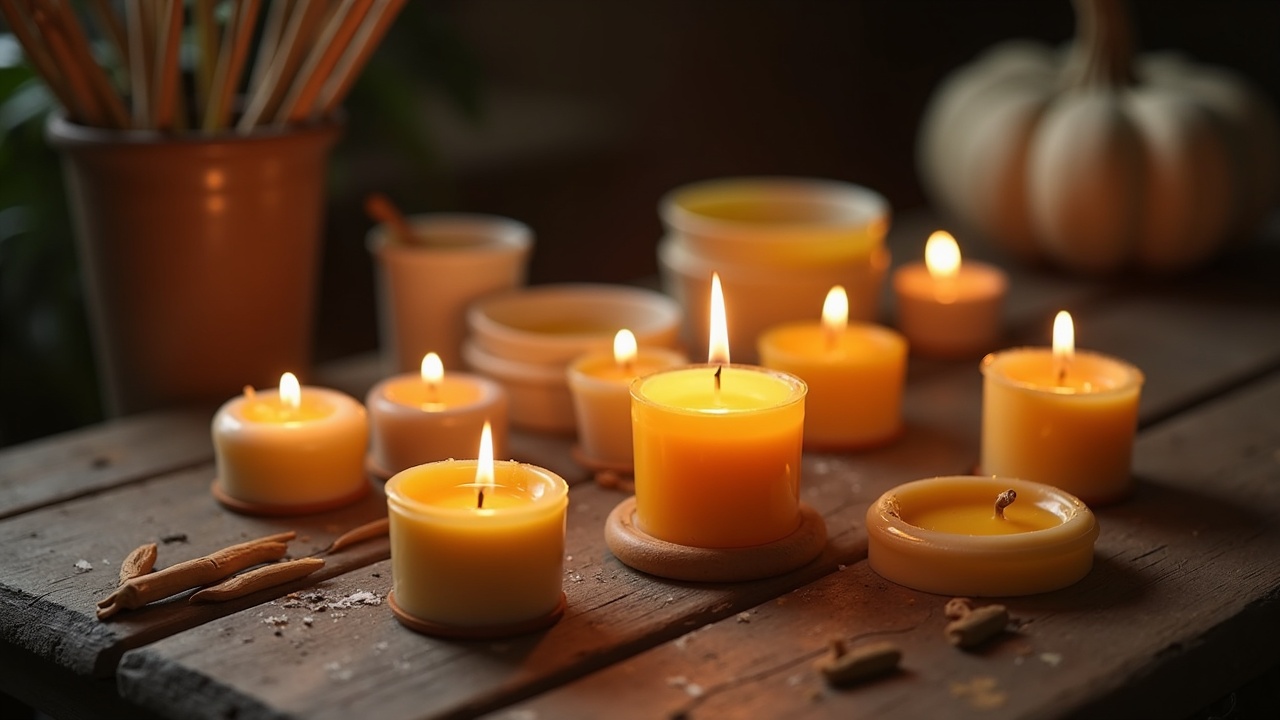
Topic: Candle Making — From Raw Materials to Finished Product Scope: Complete practical guide covering combustion science, wax selection, wick sizing, container and pillar candles, rendering beeswax and tallow from raw materials, scenting, and troubleshooting. Skill Level: Beginner to intermediate Tags: [practical-skills] [formulation] [beginner]
1. Introduction — The Chemistry of Combustion
A candle is a slow-release fuel delivery system. Understanding why it works prevents most beginner mistakes.
Capillary action drives the entire process. The wick is a bundle of fibers — cotton, paper, or wood — with microscopic gaps between strands. Liquid wax climbs these gaps against gravity through surface tension. The same physics that makes a paper towel absorb a spill pulls molten wax upward into the flame zone.
The wax never burns as a liquid. Heat from the flame melts solid wax into a pool. Capillary action draws liquid wax up the wick. At the top of the wick, intense heat vaporizes the wax into a gas. That gas combusts. The candle burns wax vapor, not wax.
Flame zones matter. A candle flame has distinct regions:
- Dark zone — the base of the flame, directly around the wick. Wax vapor rises here but has not yet reached ignition temperature. No light is produced.
- Blue zone — surrounds the dark zone at the flame's base. Hydrocarbon gases meet oxygen and undergo complete combustion. This is the hottest part of the flame, reaching approximately 1,400C (2,550F).
- Yellow zone — the visible body of the flame. Incomplete combustion produces incandescent carbon particles (soot). These glow yellow-white before being consumed. This zone runs around 1,000C (1,830F).
A well-made candle balances fuel delivery (wick size and wax viscosity) against oxygen supply (container opening and draft). Too much fuel and the flame smokes. Too little and it drowns.
Michael Faraday's 1848 Christmas Lectures at the Royal Institution, published as The Chemical History of a Candle, remain one of the clearest explanations of combustion science ever written. The fundamental chemistry has not changed.
2. Wax Types
Every wax has a melt point, a viscosity curve, and a price. Choosing the right one depends on what you are making.
Beeswax
- Melt point: 62-65C (144-149F)
- Burn characteristics: Long, slow burn. Naturally hard. Slight honey scent. Burns cleanest of all natural waxes with minimal soot.
- Cost: $12-20/lb retail for filtered yellow beeswax. The most expensive option unless you keep bees.
- Notes: High melt point makes it excellent for pillars and tapers without additives. Can be blended with softer waxes to reduce cost while keeping structural integrity.
Tallow (Rendered Animal Fat)
- Melt point: 45-50C (113-122F) depending on source animal and rendering quality
- Burn characteristics: Moderate burn time. Properly rendered tallow burns clean. Poorly rendered tallow smells like a kitchen.
- Cost: Free to $3/lb if sourced from a butcher. The cheapest candle fuel available.
- Notes: Beef tallow (suet) is the standard for candle-grade tallow. Must be rendered and clarified multiple times. Historical candle fuel for centuries before paraffin.
Soy Wax
- Melt point: 46-57C (115-135F) depending on blend
- Burn characteristics: Slow, cool burn. Excellent scent throw. Soft wax — container use only unless blended.
- Cost: $5-8/lb retail for candle-grade flakes
- Notes: Most common beginner wax. Forgiving pour temperatures. Prone to frosting (white crystalline surface patterns) which is cosmetic, not functional. Hydrogenated soybean oil.
Coconut Wax
- Melt point: 38-43C (100-109F)
- Burn characteristics: Very slow burn. Excellent hot throw (scent while burning). Creamy appearance.
- Cost: $8-14/lb retail
- Notes: Too soft for standalone use in most applications. Usually blended with soy, beeswax, or paraffin for structure. Premium product positioning.
Palm Wax
- Melt point: 55-60C (131-140F)
- Burn characteristics: Hard wax. Good burn time. Creates distinctive crystalline patterns on the surface.
- Cost: $4-7/lb retail
- Notes: Controversial due to deforestation concerns. If used, source RSPO-certified only. Hard enough for pillars without additives.
Paraffin
- Melt point: 46-68C (115-154F) depending on grade
- Burn characteristics: Strong hot throw, bright flame. Burns faster than vegetable waxes. Produces more soot.
- Cost: $2-5/lb retail. Cheapest refined option.
- Notes: Petroleum byproduct. Available in multiple melt-point grades — low (container), medium (votives), high (pillars/tapers). Industry standard for commercial candles. Most consistent and predictable wax to work with.
Cost Comparison Per Pound (Retail, 2024)
| Wax | Cost/lb | Best Use | Melt Point Range |
|---|---|---|---|
| Tallow | $0-3 | Containers, dipped tapers | 45-50C |
| Paraffin | $2-5 | All applications | 46-68C |
| Palm | $4-7 | Pillars, votives | 55-60C |
| Soy | $5-8 | Containers | 46-57C |
| Coconut | $8-14 | Containers (blended) | 38-43C |
| Beeswax | $12-20 | Pillars, tapers, rolled | 62-65C |
3. Wick Science
The wick is the most underestimated component. It controls burn pool diameter, flame height, smoke output, and scent throw. Get the wick wrong and nothing else matters.
Cotton vs. Wood
Cotton wicks are braided or knitted strands, sometimes with a paper or zinc core for rigidity. They curl as they burn, which is intentional — the curl moves the tip of the wick into the hottest part of the flame, causing it to self-trim. Flat-braided wicks curl more than square-braided wicks.
Wood wicks are thin strips of wood (or wood-fiber composites) that produce an audible crackle. They do not curl or self-trim. They require periodic manual trimming during long burns. Wood wicks create a wider, shorter flame and a broader melt pool relative to their size.
Wick Sizing by Container Diameter
Wick sizing is the single most important decision in candle making. Manufacturers publish sizing charts, but they are starting points — you must test.
The goal: a full melt pool (liquid wax edge-to-edge) within 2-3 hours of lighting, without the flame exceeding 1.5 inches in height.
General guidelines for cotton wicks in soy wax containers:
| Container Diameter | Wick Size Range |
|---|---|
| 2-2.5 inches | CDN 2-6, ECO 2-4 |
| 2.5-3 inches | CDN 8-12, ECO 6-8 |
| 3-3.5 inches | CDN 14-18, ECO 10-12 |
| 3.5-4 inches | CDN 20-24, ECO 14-16 |
| 4+ inches | Multiple wicks required |
These ranges shift based on wax type, fragrance load, and dye. Paraffin burns hotter — size down. Beeswax is dense — size up.
Why Wick Size Determines Everything
Tunneling — wick too small. The melt pool never reaches the container walls. Wax builds up on the sides. The candle burns a tunnel down the center, wasting up to 50% of the wax. Once tunneling starts, it generally cannot be corrected.
Mushrooming — wick too large or untrimmed. Carbon buildup forms a mushroom shape at the wick tip. The oversized carbon deposit disrupts the flame, produces soot, and can cause the flame to flicker erratically.
Smoking — wick too large, wick untrimmed, or draft exposure. The wick delivers more fuel than can be completely combusted. Unburned carbon particles exit the flame as visible soot.
Drowning — wick too small or wax pool too deep. The flame cannot generate enough heat to maintain capillary draw. The flame shrinks and extinguishes.
Always test three wick sizes for any new candle — your best guess, one size up, and one size down. Burn-test each for a minimum of 4 hours.
4. Equipment
Candle making requires minimal specialized equipment. Most of it is kitchen-grade.
Essential Equipment
- Double boiler or makeshift equivalent — A large pot with water and a smaller pot or pouring pitcher nested inside. Wax should never contact a direct heat source. Direct heat causes uneven melting, scorching, and flash-point risk. A purpose-built wax melting pot with pour spout costs $15-25 and is worth it.
- Thermometer — Infrared (point-and-shoot) or candy thermometer. You need accurate readings from 120F to 220F. Digital instant-read thermometers work. Do not guess temperatures.
- Pouring pot — Stainless steel pitcher with a pour spout. Holds 2-4 lbs of wax. Dedicated to wax — do not return it to kitchen use.
- Scale — Digital kitchen scale accurate to 0.1 oz or 1 gram. Wax and fragrance are measured by weight, never volume.
- Wick centering devices — Wick bars, clothespins, or chopsticks laid across the container opening to hold the wick centered during pour and cooling.
- Wick stickers or hot glue — To anchor the wick tab to the bottom of the container before pouring.
- Heat gun or torch — For smoothing tops, fixing surface imperfections, and reheating for second pours.
Molds
- Metal molds — aluminum or tin. Best heat transfer, cleanest release, sharpest detail. Standard for production pillar candles.
- Silicone molds — Flexible, easy release, infinite shapes. Lower heat transfer means slower cooling and potential surface issues.
- Polycarbonate molds — Clear plastic. Good for monitoring wax level during pour. Limited to moderate temperatures.
Containers
Mason jars, ceramic vessels, tin cans, heat-safe glass. The container must tolerate temperatures up to 180F without cracking. Thin-walled glass is risky — use vessels rated for candle use or test with boiling water first. The container must be wider than it is tall for optimal burn performance.
5. Container Candles — Process
Container candles are the most forgiving format and the best starting point.
Step-by-Step Process
1. Prepare the container. Clean and dry. Attach the wick tab to the center bottom using a wick sticker or dot of hot glue. Place the wick centering bar across the top. The wick should be taut and centered.
2. Measure wax. Fill the container with wax flakes to estimate volume, then weigh. Alternatively, fill the container with water, weigh it, and multiply by 0.86 (wax is less dense than water). Melt 10% more than your estimate to account for contraction.
3. Melt wax. Heat in a double boiler. Stir occasionally. Target temperature depends on wax type:
- Soy wax: melt to 170-180F
- Paraffin: melt to 180-190F
- Coconut blends: melt to 160-170F
- Beeswax: melt to 170-180F
4. Add fragrance. Remove from heat. Cool to the manufacturer's recommended fragrance addition temperature (typically 135-145F for soy, 160-170F for paraffin). Add fragrance oil by weight — typically 6-10% of wax weight. Stir gently for 2 full minutes to ensure binding.
5. Add dye (optional). Liquid dye: 2-4 drops per pound. Dye blocks: shave thin slices and stir until dissolved. Add dye before or with fragrance.
6. Pour. Target pour temperature:
- Soy: 120-140F
- Paraffin: 150-160F
- Coconut blends: 120-135F
- Beeswax: 145-160F
Pour slowly and steadily. Avoid splashing. Leave 0.5 inches of headspace below the container rim.
7. Cool. Room temperature, no drafts, no refrigeration. Rapid cooling causes cracking, sinkholes, and adhesion problems. Cooling takes 4-12 hours depending on container size and wax type.
8. Second pour (if needed). Most waxes contract as they cool, creating a sinkhole around the wick. Poke 2-3 relief holes around the wick with a chopstick. Reheat leftover wax to pour temperature and top off. Smooth with a heat gun if needed.
9. Trim wick. Cut to 1/4 inch above the wax surface.
10. Cure. This step is critical and frequently skipped. Curing allows the fragrance oil to fully bind with the wax matrix. Minimum cure times:
- Soy: 7-14 days
- Paraffin: 3-5 days
- Coconut blends: 14 days
- Beeswax: 5-7 days
Burn-testing before cure is complete gives false results for scent throw.
6. Pillar and Taper Candles
Pillar Candles
Pillar candles are freestanding — no container. The wax must be hard enough to hold its shape at room temperature.
Suitable waxes: Beeswax (no additives needed), paraffin (use 140F+ melt point grade), palm wax, or soy blended with 20-30% beeswax or stearic acid.
Mold preparation. Metal molds: apply a thin coat of mold release spray or vegetable oil. Silicone molds: no release agent needed. Thread the wick through the mold's bottom hole, seal with mold putty or hot glue to prevent leaking, and secure at the top with a wick bar.
Pour temperature. 190-200F for paraffin pillars. 170-180F for beeswax. Hotter pours give smoother surfaces.
Cooling. Pillar molds cool from the outside in. The center contracts last, creating a deep sinkhole. Poke relief holes every 30-45 minutes during cooling and top off with hot wax.
Demolding. Wait until the candle is fully cooled — at least 12 hours for a 3-inch pillar. If stuck, place the mold in the freezer for 10 minutes. Thermal contraction will release the candle. Do not force it.
Taper Candles
Dipping method — the traditional technique. Requires a dipping vat tall enough for the desired taper length (typically 10-12 inches).
- Melt wax to 155-165F for paraffin, 160-170F for beeswax.
- Cut wick lengths to double the finished taper length plus 4 inches for handling.
- Drape wick over a dipping rod or dowel so both halves hang evenly — this produces two tapers per wick.
- Dip into wax for 3-5 seconds. Lift straight out.
- Allow to cool for 60-90 seconds between dips.
- Repeat 25-35 times until desired diameter is reached (standard taper base is 7/8 inch).
- While still slightly warm, roll on a smooth surface to straighten and smooth.
- Trim the base flat with a sharp knife while wax is still pliable.
Each dip adds approximately 1/32 inch of diameter. Patience is the only requirement.
Mold-poured tapers use specialized taper molds. Faster than dipping but less traditional. Same principles as pillar candles — wick through the bottom, seal, pour, cool, demold.
7. Beeswax Rendering
Raw beeswax from the hive contains propolis, pollen, dead bees, cocoon casings, and honey residue. It must be rendered before candle use.
Solar Wax Melter
The simplest and cheapest method. Build or buy an insulated box with a glass or polycarbonate lid, angled to face the sun. Place a metal tray inside with raw comb. The sun melts the wax, which drips through a filter (paint strainer bag or cheesecloth) into a collection container below.
- Works in direct sun above 85F ambient temperature
- Slow — processes 2-5 lbs of comb per day
- Free energy cost
- First-pass rendering only — produces wax that needs further filtering
Water Bath Method
Faster and more controlled.
- Break raw comb into small pieces. Remove as much visible debris as possible.
- Place comb in a large stainless steel pot. Add water to cover by 2 inches.
- Heat slowly to 170F. Do not boil — boiling darkens the wax and can emulsify contaminants into it.
- Stir occasionally as wax melts. Debris sinks or floats.
- When fully melted, strain through cheesecloth or a fine-mesh bag into a clean container.
- Allow to cool completely. Wax solidifies on top of the water. Debris and honey settle into the water below.
- Pop the wax disc off the water. Scrape any dark residue from the bottom of the disc.
- Repeat the melt-and-filter process 2-3 times until the wax is clean and uniform in color.
Filtered beeswax should be golden yellow with a faint honey scent and no visible particulates.
Yield: Expect 60-70% clean wax by weight from raw comb. Old, dark brood comb yields less. Fresh cappings wax yields the most and cleanest product.
8. Tallow Rendering
Tallow is rendered animal fat — specifically, the hard fat surrounding the kidneys and loins (suet). Beef suet produces the hardest, cleanest-burning tallow for candles.
From Suet to Candle-Grade Tallow
1. Source suet. Request kidney fat or suet from a butcher. It is often free or $1-2/lb because most butchers discard it. Fresher is better — old suet develops off-odors that carry through rendering.
2. Prepare. Remove any meat, blood, or membrane. Cut into 1-inch cubes or run through a meat grinder. Smaller pieces render faster and more completely.
3. Render — wet method (recommended for candle-grade). Place suet in a large pot. Add water — 1 cup per pound of suet. Heat on low (200-220F). Stir every 15-20 minutes. The fat melts out of the connective tissue over 3-6 hours. Do not fry — if the cracklins (solid bits) brown, the temperature is too high and the tallow will smell.
4. Strain. Pour through cheesecloth or a fine-mesh strainer into a heat-safe container. Press the cracklins to extract remaining fat. Discard solids or use as animal feed.
5. Clarify — first pass. Allow strained tallow to cool and solidify (overnight). Pop the tallow disc off the water. Scrape the bottom — a gelatin layer of impurities collects between the tallow and water. Discard the water and gelatin.
6. Clarify — second pass. Melt the tallow again with fresh water. Add 1 tablespoon of salt per pound of tallow. Bring to a gentle simmer (not a boil) for 15 minutes. Cool and solidify overnight. Pop off and scrape again.
7. Clarify — third pass (optional but recommended for candle use). Repeat step 6. Each pass removes more impurities and odor. Three-pass tallow should be white to cream-colored and nearly odorless when solid.
Yield: 1 lb of raw suet produces approximately 0.7-0.8 lb of rendered tallow.
Storage: Finished tallow stores at room temperature for months in a sealed container. Refrigerated, it keeps for over a year. If it develops a rancid smell, it has oxidized and will produce off-odors when burned.
9. Scenting
Essential Oils vs. Fragrance Oils
Essential oils are steam-distilled or cold-pressed from plant material. They are single-ingredient, unmodified extracts. Pros: natural origin, therapeutic properties (if that matters to you), no synthetic chemicals. Cons: expensive, inconsistent scent throw in candles, many have low flash points, limited scent palette.
Fragrance oils are synthetic or semi-synthetic aromatic compounds engineered for candle use. Pros: consistent performance, strong hot throw, enormous variety, designed to bind with wax. Cons: synthetic, variable quality between suppliers.
For candle making specifically, fragrance oils outperform essential oils in scent throw and consistency. This is not a quality judgment — it is a chemistry fact. Fragrance oils are formulated to volatilize at candle-burning temperatures. Most essential oils are not.
Flash Points
The flash point is the temperature at which a volatile compound produces enough vapor to ignite. This matters.
If you add a fragrance oil with a 130F flash point to wax at 180F, a significant portion of the scent compound vaporizes on contact and is lost. It does not combust in the pot (the concentration is too low), but it does not end up in the candle either.
Rule: Always add fragrance at or below the flash point of the oil, and at or above the wax manufacturer's recommended fragrance-binding temperature. If these ranges conflict, add at the lowest temperature that still allows proper binding — typically 135-145F for soy wax.
Maximum Fragrance Load
Every wax has a fragrance saturation point. Exceeding it causes:
- Fragrance oil seeping to the surface (sweating)
- Wet spots and adhesion loss in containers
- Clogged wick causing poor burn performance
- Potential flame flare-ups from pooled oil
Standard maximum loads:
- Soy wax: 10-12% by weight
- Paraffin: 10-12% by weight
- Coconut wax: 8-10% by weight
- Beeswax: 6-8% by weight (beeswax has limited fragrance binding capacity)
A 6-8% load is the practical working range for most applications. More is not better.
10. Troubleshooting
Wet Spots
Symptom: Visible patches where wax pulls away from the glass container wall, creating an uneven appearance. Cosmetic only — does not affect burn.
Cause: Differential cooling rates between wax and glass. The wax nearest the glass cools first, contracts, and separates.
Fix: Preheat containers to 100-120F before pouring. Pour at the lowest recommended temperature. Cool in a warm room (75-80F) away from drafts. Wrap containers in towels during cooling to slow the rate.
Sinkholes
Symptom: Cavities or depressions forming around the wick after cooling, sometimes hidden beneath a smooth surface.
Cause: Wax shrinks 5-10% by volume as it solidifies. The surface sets first, trapping air below.
Fix: Poke relief holes around the wick after initial set (when surface is firm but interior is still soft). Top off with wax at the same pour temperature. For large candles, do this twice.
Poor Hot Throw
Symptom: Candle smells weak or unscented while burning, even though cold throw (unlit scent) is strong.
Cause: Fragrance added at wrong temperature (too hot = evaporation loss, too cold = poor binding). Wick too small (inadequate melt pool = insufficient fragrance release). Insufficient cure time. Low-quality fragrance oil not designed for wax.
Fix: Verify fragrance addition temperature against flash point. Test one wick size up. Allow full cure time. Source fragrance oils from candle-specific suppliers.
Frosting
Symptom: White crystalline patterns on the surface or sides of the candle. Most common in soy wax.
Cause: Polymorphism — soy wax naturally forms crystal structures as it cools and ages. This is an inherent property of vegetable waxes.
Fix: There is no permanent fix. Pouring at lower temperatures and adding a small percentage (1-3%) of coconut oil or a soy additive can reduce it. Frosting is cosmetic and does not affect performance. Many makers embrace it as proof of natural wax.
Tunneling
Symptom: Candle burns a narrow channel down the center, leaving thick walls of unmelted wax.
Cause: Wick too small for container diameter. Or — first burn was too short. Wax has memory: the melt pool diameter on the first burn sets the pattern for subsequent burns.
Fix: Prevention — use the correct wick size and burn the candle for 1 hour per inch of diameter on the first burn to establish a full melt pool. Correction — wrap the top of the container in aluminum foil (leaving a small opening for the flame) to reflect heat inward and force a wider melt pool. This is a partial fix at best. Proper wick sizing prevents the problem entirely.
Mushrooming
Symptom: Carbon buildup forming a mushroom or ball shape at the wick tip.
Cause: Wick too large — delivering more fuel than the flame consumes. Carbon deposits accumulate. Can also result from high fragrance loads or certain fragrance oil chemistries.
Fix: Size down one wick. Trim wick to 1/4 inch before every burn. If the problem persists with a smaller wick, reduce fragrance load by 1-2%.
Cracking
Symptom: Visible cracks in the wax body, especially in pillar candles.
Cause: Cooling too fast. Thermal shock from cold molds or cold environments. Pour temperature too low.
Fix: Pour into room-temperature or preheated molds. Cool slowly in a warm room. Avoid drafts, air conditioning vents, and cold surfaces during cooling.
11. Sources
- Faraday, M. (1861). The Chemical History of a Candle. Royal Institution Christmas Lectures, 1848. Published by Chatto & Windus, London.
- National Candle Association. "How Candles Work." https://candles.org/candle-science/
- Egan, D. (2016). The Complete Candlemaker. Sterling Publishing.
- Oppenheimer, B. (2001). Candlemaking for Fun & Profit. Tom doherty Associates.
- Webb, S. (2020). The Natural Soy Candle Making Book. Rockridge Press.
- National Candle Association. "Candle Safety." https://candles.org/fire-safety-candles/
- Mann, J.C. et al. (2020). "Characterization of Volatile Organic Compounds from Candle Emissions." Journal of Environmental Health, 82(6), 10-17.
- ASTM F2417-17. Standard Specification for Fire Safety for Candles.
- Root Candles. "Beeswax Candle Making Guide." A.I. Root Company technical documentation.
- CandleScience.com. Wick sizing guides and technical specifications. https://www.candlescience.com/learning/wick-guide