plants
Fire Starting Methods and Fire Management
Fire Starting Methods and Fire Management - comprehensive guide from Nored Farms.
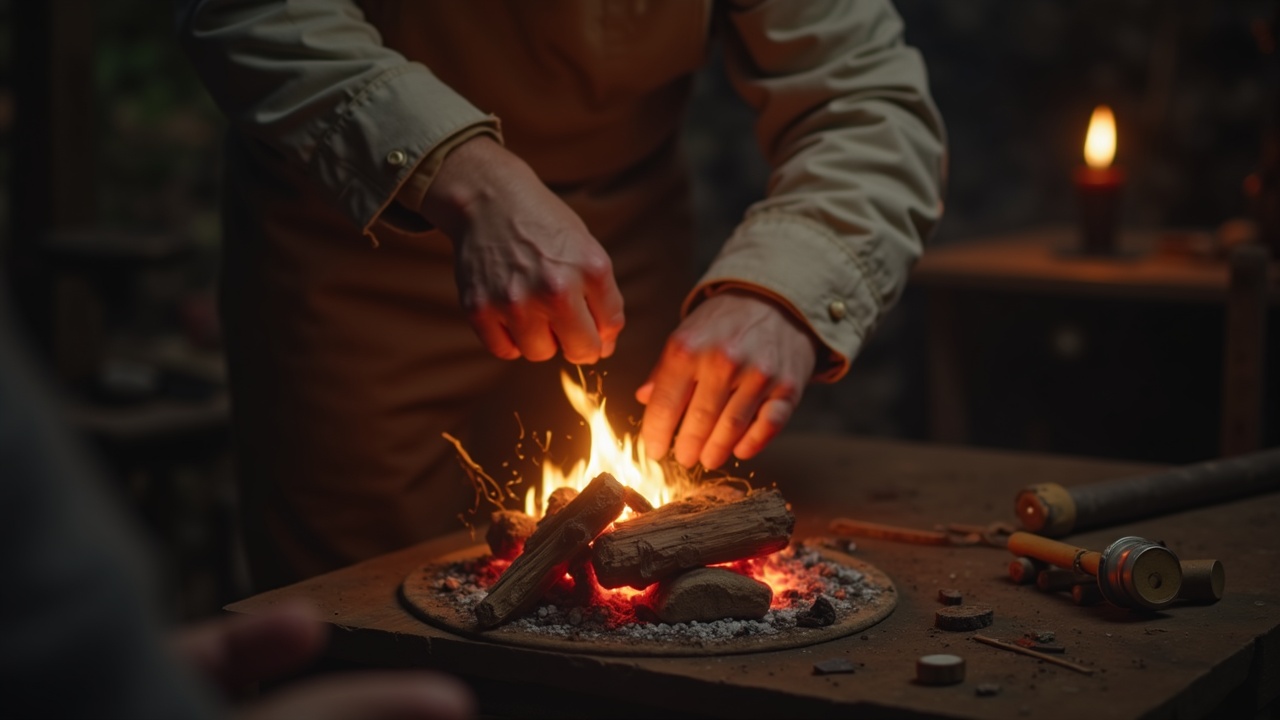
Content Extraction Summary
Hook Options
- The single most common reason a fire fails is not bad tinder or wet wood — it is insufficient oxygen. The fire triangle (heat, fuel, oxygen) is a diagnostic framework, and oxygen is the variable most people ignore while obsessing over the other two.
- A properly made bow drill fire set from willow or cottonwood can produce an ember in under 30 seconds. Most failures come from wrong wood pairing, not lack of effort — spindle and fireboard must be close in hardness or the harder piece simply wears a hole in the softer one without generating enough friction heat.
- Birch bark ignites even when wet because the paper-thin outer layers contain betulin, a waxy triterpene that burns at high temperature and resists moisture penetration. This is why birch bark has been the primary fire-starting tinder across every northern culture for thousands of years.
Key Mechanism
Fire requires three elements in simultaneous contact: heat sufficient to reach ignition temperature, fuel with enough surface area to combust at that temperature, and oxygen to sustain the chemical reaction. Remove any one and the fire dies. Every fire-starting method is simply a strategy for delivering all three at once — the differences are only in how you generate the initial heat.
Misconception to Correct
Most people think fire-starting skill means mastering exotic ignition methods. In practice, 90% of fire success or failure happens in material preparation — selecting, processing, and staging tinder, kindling, and fuel before any spark is struck. A person with a perfect bow drill technique and poorly prepared materials will fail. A person with a cheap lighter and expertly staged materials will succeed in a rainstorm.
Practical Application
Build every fire in three graduated stages: a tinder bundle the size of a softball with material fine enough to catch a spark, a kindling stack sorted into three thickness grades (pencil-lead, pencil, thumb), and fuel wood split to forearm-diameter or smaller and arranged so air flows through the structure. Light the tinder, feed kindling by thickness from thin to thick, then add fuel only after sustained flame. This staging sequence works regardless of ignition method, weather, or wood species.
Citation-Ready Claims
- [Betulin content of birch bark 10-30% dry weight] --> [Explains moisture-resistant ignition] --> [Krasutsky, P.A. (2006). Birch bark research and development. Natural Product Reports, 23(6), 919-942]
- [Ferrocerium sparks reach 3,000degC / 5,430degF] --> [Exceeds ignition temperature of all natural tinders] --> [Federal Emergency Management Agency, Fire Behavior curriculum]
- [Oak produces 24.6 million BTU per cord] --> [Highest common hardwood fuel value] --> [USDA Forest Service, Firewood BTU Ratings, FPL-GTR-190]
- [Bow drill friction ignition occurs at ~400degF / 204degC at the contact point] --> [Lower than match ignition temp] --> [Hoadley, R.B. (2000). Understanding Wood. Taunton Press]
Fire Starting Methods and Fire Management
*Pure Euphoria Botanicals -- Nored Farms -- Austin, Texas*
1. Introduction
Fire is the oldest and most consequential human technology. Control of fire predates anatomically modern humans — charred remains at Wonderwerk Cave in South Africa date controlled fire use to roughly 1 million years ago (Berna et al., 2012, Proceedings of the National Academy of Sciences). Every subsequent technology — metallurgy, ceramics, agriculture, chemistry — descends from it.
The fire triangle is not a diagram you memorize. It is a real-time diagnostic tool. Every failed fire is missing one of three things: heat, fuel, or oxygen. When your fire smokes and sputters, you are looking at incomplete combustion — usually insufficient airflow or fuel that is too wet or too large to reach ignition temperature from the available heat. When your fire flashes and dies, you had heat and oxygen but ran out of fuel at the right size. Diagnosing which leg of the triangle is failing tells you exactly what to fix.
**The critical concept most people miss:** fire is a chain reaction with stages. You do not light a log. You light tinder, which lights kindling, which lights fuel. Each stage must produce enough heat to ignite the next size class of material. Skip a stage — go from tinder directly to wrist-thick wood — and the fire dies because the heat output of burning tinder cannot raise thick wood to ignition temperature.
This document covers material selection, ignition methods from modern to primitive, fire architecture, wet-weather techniques, overnight fire management, and safety. A person who reads and practices this material should be able to build a sustainable fire in any conditions with any available ignition source — or with no manufactured ignition source at all.
2. Tinder — The Foundation
Tinder is any material fine enough to ignite from a spark or small ember and sustain flame long enough to light kindling. The defining characteristic of good tinder is its surface-area-to-mass ratio. The higher the ratio, the less heat required for ignition.
Natural Tinders
**Birch bark** is the gold standard for natural tinder worldwide. The outer papery layers contain betulin (10-30% of dry weight), a hydrophobic triterpene compound that ignites readily and burns hot even when the bark surface is damp (Krasutsky, 2006). Peel thin curls from live or dead birch — the thinner the better. Do not strip bark in a full ring around a live tree; this kills it. Take vertical strips from one side.
**Fatwood** is resin-saturated heartwood from dead conifers, most commonly pine. When a pine tree dies, the resin concentrates in the heartwood as the sapwood decays. The result is wood so saturated with terpene-based resin that it ignites from a spark and burns like a candle. Find it at the base of dead pine stumps and at branch junctions. It feels heavy for its size and smells strongly of pine resin when scraped. Shave it into thin curls for tinder or use pencil-sized sticks as kindling.
**Cedar bark** (eastern red cedar, western red cedar, or juniper) shreds into fine fibers that catch a spark reliably. Pull bark strips from dead standing cedar, then shred and roll between your palms until you have a loose, fibrous bundle. Cedar bark tinder bundles are the standard choice for bow drill and hand drill fires because the fibers hold an ember well and transition to flame with gentle blowing.
**Cattail fluff** — the mature seed heads of Typha species — ignites from a single spark. It burns fast and hot but very briefly. Use it as a flash tinder to ignite a more substantial tinder bundle, not as your primary tinder. Cattail fluff compressed too tightly will not ignite because air cannot reach the fibers; keep it loose.
**Pine resin** collected from wound sites on living conifers is essentially solid turpentine. It ignites easily, burns hot, and resists moisture. Collect hardened resin nodules and crush them into smaller pieces to mix with fibrous tinder. Resin alone melts and drips rather than sustaining flame in a useful shape — always combine it with a fiber base.
**Char cloth** is cotton fabric that has been pyrolyzed (heated without oxygen) until it is pure carbon. It catches a spark from flint-and-steel or ferrocerium with extreme reliability and holds a glowing ember for minutes. To make it: cut 100% cotton fabric (old t-shirts, denim) into 2-inch squares, place them in a small metal tin with a single small hole punched in the lid, and set the tin on hot coals or a stove burner. Smoke will vent from the hole. When the smoke stops, remove the tin and let it cool sealed. The cloth inside will be black, fragile, and will catch a spark on the first strike.
Prepared Tinders
**Cotton balls with petroleum jelly** are the most reliable prepared tinder available. Work a generous amount of petroleum jelly into a cotton ball until it is saturated but not dripping. One prepared cotton ball burns for 3-5 minutes with a strong flame — long enough to dry and ignite marginal kindling. Store them in a small waterproof container. They weigh almost nothing and cost less than a penny each. There is no reason not to carry them.
**Dryer lint** works as tinder only if it comes from loads of 100% cotton or mostly-cotton fabrics. Synthetic-fiber lint melts rather than burning and can be difficult to ignite. Test yours before relying on it.
**Wax-soaked materials** — cotton rounds dipped in paraffin, wax-saturated sawdust, wax-dipped cardboard — all function as extended-burn tinders. The wax provides waterproofing and extended burn time; the fiber base provides surface area for ignition.
What Makes Good Tinder
The physics are simple. Ignition temperature for most cellulose-based materials is roughly 450-500 degrees F (232-260 degrees C). The heat from a spark or ember must raise the tinder material to that temperature. Thin, dry, fibrous materials with high surface-area-to-mass ratios reach ignition temperature faster because there is less mass to heat. This is why shaved curls light and logs do not.
Moisture is the enemy of tinder because water absorbs enormous amounts of heat (540 calories per gram to evaporate). Wet tinder must first be dried by the available heat before it can reach ignition temperature. This is why keeping tinder dry — in a pocket, in a sealed bag, under your hat — is one of the most important fire-starting habits.
3. Kindling — The Bridge
Kindling is the bridge between tinder flame and sustained fire. It must be small enough to ignite from tinder but substantial enough to produce coals and heat that can ignite fuel-sized wood.
Sizing Progression
Sort kindling into three size grades and add them in order:
1. **Pencil-lead thickness** (1/8 inch / 3mm) — catches from tinder flame within seconds. Dead twigs, shaved wood curls, split slivers. 2. **Pencil thickness** (1/4 inch / 6mm) — catches from the first grade burning. Small dead branches, split sticks. 3. **Thumb thickness** (3/4 inch / 20mm) — catches from the second grade and produces enough heat and coals to ignite fuel wood. Split sticks, small dead branches.
**The most common fire-building mistake is jumping from tinder directly to thumb-thick kindling.** Tinder flame does not produce enough sustained heat to ignite material that thick. You must graduate through the sizes.
Species Selection
Softwoods (pine, cedar, spruce, fir) make superior kindling because they ignite at lower temperatures and catch faster than hardwoods. Resinous softwoods are even better — pine and spruce kindling essentially has built-in accelerant. Save hardwood for fuel.
Dead, dry branches still attached to trees ("squaw wood" or "standing dead") are almost always drier than anything on the ground, even in rain. Branches on the ground wick moisture from soil. Snap dead branches from tree trunks — if they snap cleanly with a crack, they are dry enough. If they bend, they are too wet or too green.
Feather Sticks
A feather stick is a piece of dry wood with thin curls shaved along its length but left attached, creating a cluster of tinder-like shavings on a kindling-sized stick. It bridges the gap between tinder and kindling in a single piece. Use a sharp knife with a controlled push cut. Angle the blade about 20 degrees to the wood surface. Curl as thin as possible — the thinner the curls, the easier they ignite. A good feather stick with 15-20 fine curls will catch a spark directly, bypassing the need for separate tinder.
Batoning
Batoning is splitting wood using a knife and a baton (a heavy stick used as a hammer). Place the knife edge on the end of a piece of wood, strike the spine of the knife with the baton, and drive the blade through the wood to split it. This technique lets you access the dry interior of wet wood and process rounds into kindling-sized pieces without an axe. Your knife blade must be longer than the diameter of the wood you are splitting. Full-tang fixed-blade knives handle batoning; folding knives do not.
4. Fuel — Sustained Fire
Fuel wood determines how hot your fire burns, how long it lasts, and how much usable coal it produces. Species selection matters far more than most people realize.
BTU Chart by Wood Species
Heat output is measured in BTUs (British Thermal Units) per cord (128 cubic feet stacked). Higher BTU means more heat per unit of wood. Data from USDA Forest Service, Forest Products Laboratory (FPL-GTR-190).
| Species | BTU per Cord (millions) | Coaling Quality | Spark/Pop | Smoke | Split Ease | Notes | |---|---|---|---|---|---|---| | Osage Orange | 32.9 | Excellent | Low | Low | Hard | Highest BTU of any North American wood. Burns extremely hot. | | Shagbark Hickory | 27.7 | Excellent | Low | Low | Moderate | Classic firewood. Long, even burn. | | Black Locust | 27.9 | Excellent | Low | Low | Hard | Dense, rot-resistant. Burns very hot with good coals. | | White Oak | 25.7 | Excellent | Low | Low | Moderate | Steady, long burn. Gold standard for cooking fires. | | Sugar Maple | 24.0 | Excellent | Low | Low | Easy | Clean burn, easy to split, excellent all-around. | | Red Oak | 24.6 | Good | Low | Low | Easy | Slightly faster burn than white oak. Easy to find and split. | | Ash (White) | 23.6 | Good | Low | Low | Very Easy | Splits easily even green. Burns well even partially seasoned. | | Mesquite | 25.0+ | Excellent | Low | Low (flavored) | Hard | Extremely dense. Prized for cooking. Difficult to split. | | Pecan | 20.9 | Good | Low | Low (flavored) | Moderate | Good heat, pleasant cooking smoke. | | Birch (Yellow) | 21.8 | Fair | Low | Moderate | Easy | Burns hot but fast. Bark is excellent tinder. | | Cherry | 20.4 | Good | Low | Low (flavored) | Easy | Moderate heat, excellent cooking smoke flavor. | | Elm (American) | 20.0 | Fair | Low | Moderate | Very Hard | Interlocking grain resists splitting. Adequate heat. | | Pine (Southern Yellow) | 20.5 | Poor | High | High | Easy | High resin. Pops, sparks, creosote. Good for starting, poor for sustained. | | Cedar (Eastern Red) | 13.0 | Poor | High | Moderate | Very Easy | Burns fast and hot initially. Pops and sparks heavily. | | Cottonwood | 15.8 | Poor | Low | High | Easy | Low heat, fast burn. Emergency fuel only. | | Willow | 14.5 | Poor | Low | High | Easy | Low heat. Burns fast. Better as bow drill material than fuel. |
Green vs. Dead vs. Seasoned
**Green (live) wood** contains 30-60% moisture by weight depending on species and season. It will not sustain combustion without an already-hot fire providing the heat to evaporate that water. Green wood on a campfire smokes, hisses, and suppresses the fire.
**Dead wood** still on the tree or recently fallen varies from 15-40% moisture depending on how long it has been dead and weather exposure. Dead branches still attached to trees above ground are the driest wild-sourced wood you will find because they are off the ground and air-dried in place.
**Seasoned wood** has been cut, split, and air-dried for 6-12 months (softwood) or 12-24 months (hardwood) to reach 15-20% moisture content. This is the standard for efficient burning. Seasoned wood is lighter than green, has visible cracks in the end grain, and sounds hollow when two pieces are knocked together.
Hardwood vs. Softwood
**Hardwood** (oak, hickory, maple, mesquite) is dense, burns slowly, produces excellent coals, and generates sustained high heat. Use hardwood for cooking fires, overnight fires, and any situation where you need long burn time and a coal bed.
**Softwood** (pine, cedar, spruce, fir) is less dense, ignites faster, burns hotter initially but faster, and produces fewer coals. Use softwood for starting fires and for quick warming fires. Resinous softwoods create creosote buildup in chimneys and should not be the primary fuel for indoor stoves or fireplaces.
Fire Lays
**Teepee/Tipi** — Kindling and fuel leaned together in a cone shape over the tinder bundle. Advantages: concentrates heat upward, ignites quickly, good for starting a fire fast. Disadvantages: collapses as pieces burn through, requires frequent tending, not ideal for cooking.
**Log cabin** — Fuel pieces stacked in alternating perpendicular layers, forming a square structure with the tinder bundle in the center. Advantages: stable, excellent airflow through the gaps, collapses into a flat coal bed perfect for cooking. Disadvantages: uses more wood, takes longer to ignite fully.
**Lean-to** — A large piece of fuel laid as a windbreak with kindling leaned against it on the downwind side, tinder placed under the kindling. Advantages: provides wind protection, reflects heat, simple construction. Disadvantages: one-directional heat, burns unevenly.
**Top-down (upside-down fire)** — Largest fuel logs on the bottom, medium pieces on top of those, kindling on top of the medium pieces, tinder on the very top. You light the top. Fire burns downward. Advantages: burns for hours unattended, no collapsing structure, produces a consistent coal bed. Disadvantages: takes longer to establish, counterintuitive construction.
5. Ignition Methods
Ferrocerium Rod
A ferrocerium rod ("ferro rod") produces sparks at approximately 3,000 degrees C (5,430 degrees F) — far hotter than a match or lighter flame. The sparks are shavings of the ferro rod itself, ignited by friction and oxidation. A quality ferro rod produces reliable ignition for 10,000-20,000 strikes.
**Technique:** Hold the rod stationary against or near the tinder. Pull the scraper backward along the rod rather than pushing forward — this delivers sparks to the tinder without disrupting it. Scraping angle matters: 30-45 degrees between scraper and rod produces the largest, hottest sparks. Too shallow an angle produces small sparks; too steep skids without shaving. Use the spine of a knife, a dedicated scraper, or a sharp piece of flint.
**Common failure:** Pushing the ferro rod forward through the tinder, scattering it before sparks arrive. Anchor the rod tip and pull the scraper back.
Flint and Steel (Traditional)
True flint-and-steel fire starting uses a piece of high-carbon steel (a dedicated striker, the spine of a carbon steel knife, or an old file) struck against a sharp edge of flint, chert, jasper, or quartz. The steel shavings — not the stone — ignite from the friction. These sparks are cooler than ferrocerium (around 800-1,000 degrees C) and will only ignite char cloth or very fine punk wood, not raw natural tinder.
**Method:** Hold the char cloth against the flint with your thumb. Strike the steel downward against the flint edge so sparks land on the char cloth. When the cloth catches, place it inside a tinder bundle and blow gently to flame.
Magnifying Lens
Any convex lens — magnifying glass, eyeglass lens, binocular lens, clear ice shaped into a lens, even a water-filled plastic bag shaped into a rough sphere — can focus sunlight to ignition temperature. Hold the lens between sun and tinder, adjust distance until the focal point (smallest, brightest dot) sits on the tinder surface. Dark-colored tinder or tinder with a charred spot ignites fastest. This method only works in direct sunlight — it is useless on overcast days.
Battery and Steel Wool
Fine steel wool (#0000 grade) touched to both terminals of a 9-volt battery ignites instantly. The thin steel strands have very low resistance, so the current heats them past ignition temperature in seconds. The steel wool burns hot enough to ignite dry tinder placed in contact with it. Any battery that can deliver sufficient current works — 9-volt is easiest because both terminals are on one end. Two AA batteries in series (connected positive-to-negative) touched to steel wool also work.
Friction — Bow Drill (Overview)
The bow drill generates heat through friction between a wooden spindle rotating in a wooden fireboard. When the friction point reaches approximately 400 degrees F (204 degrees C), the wood fibers pyrolyze into a fine black powder (char) that accumulates in a notch cut into the fireboard. When enough hot char accumulates, it forms a self-sustaining coal — a glowing ember that can be transferred to a tinder bundle and blown into flame. Detailed component selection and technique are covered in Section 6.
Friction — Hand Drill
The hand drill eliminates the bow and bearing block, using only a spindle rolled between the palms directly on a fireboard. It is simpler in components but far more demanding physically. Only very specific wood pairings work reliably, and the technique requires sustained downward pressure while spinning — most people's hands drift upward during rolling, losing pressure. Mullein stalks, cattail stalks, and yucca stalks on cottonwood, willow, or cedar fireboards are traditional combinations.
6. Bow Drill Deep Dive
The bow drill is the most reliable primitive friction fire method because the bow provides mechanical advantage — you can maintain high spindle speed and strong downward pressure simultaneously, which the hand drill cannot do.
Components
A bow drill set has four parts: spindle, fireboard, bearing block, and bow.
**Spindle:** A straight, dry, smooth stick approximately 3/4 inch (20mm) in diameter and 8-12 inches (20-30cm) long. The bottom end (friction end) is carved to a blunt point. The top end (bearing end) is carved to a narrower, more pointed shape to reduce friction in the bearing block. Dead, dry wood only — no green wood, no bark remaining.
**Fireboard:** A flat piece of the same or similar wood, approximately 3/4 inch (20mm) thick, 2-3 inches (5-7cm) wide, and at least 8 inches (20cm) long. One flat side rests on the ground. A starting depression is carved on the top surface about 1/2 inch from the edge, and a V-shaped notch is cut from the edge into the depression to collect and deliver the hot char dust to a coal-catching surface below.
**Bearing block (handhold):** Holds the top of the spindle. Can be hardwood, bone, stone, antler, a knot of resin-saturated wood, or a seashell. The key requirement is that it must create less friction than the fireboard-spindle interface. Lubricate the bearing socket with resin, animal fat, crushed green leaves, earwax, or nose oil to reduce friction at the top while maximizing it at the bottom.
**Bow:** A sturdy, slightly curved stick approximately arm's length. The cord is tied at both ends with enough slack that you can twist the spindle into the cord with one wrap. Paracord, natural cordage, rawhide, or bootlaces all work. The cord must grip the spindle without slipping.
Component Compatibility Table
Spindle and fireboard must be matched in hardness. If one is significantly harder than the other, the softer piece wears away without generating enough friction heat. Both pieces should be dry, dead, and non-resinous (resin lubricates, preventing friction).
| Spindle Wood | Fireboard Wood | Compatibility | Notes | |---|---|---|---| | Willow | Willow | Excellent | Classic combination. Widely available. | | Willow | Cottonwood | Excellent | Slight hardness difference works well. | | Cottonwood | Cottonwood | Excellent | Very easy to carve, light, fast coal. | | Cottonwood | Willow | Excellent | Either piece works as spindle or board. | | Cedar (Eastern Red) | Cedar (Eastern Red) | Excellent | Aromatic dust, reliable ember. | | Cedar | Cottonwood | Good | Cedar spindle on cottonwood board preferred. | | Cedar | Willow | Good | Works well in both orientations. | | Basswood | Basswood | Excellent | Soft, light, easy to carve. Fast ember. | | Basswood | Willow | Good | Basswood spindle on willow board. | | Aspen | Aspen | Good | Similar to cottonwood. Slightly harder. | | Aspen | Willow | Good | Either orientation works. | | Yucca (root/stalk) | Cottonwood | Good | Traditional desert combination. | | Mullein (stalk) | Cottonwood | Good | Mullein stalk must be fully dried. | | Poplar | Poplar | Good | Soft and workable. Widely available in east. | | Sycamore | Sycamore | Fair | Harder. Requires more effort and speed. | | Oak | Oak | Poor | Too hard. Requires extreme effort. | | Pine | Pine | Poor | Resin lubricates contact. Usually fails. | | Maple | Maple | Poor | Too hard and dense for most practitioners. | | Hickory | Any softwood | Poor | Hardness mismatch grinds the softwood away. | | Any hardwood | Any hardwood | Poor | Excessive effort, inconsistent results. |
**Best all-around combination:** Willow spindle on cottonwood fireboard. Both are widely distributed across North America, easy to identify, easy to carve, and produce reliable coals with moderate effort.
Cord Selection
The cord must grip the spindle without slipping. Rough-textured cordage grips better than smooth. Suitable options:
- **Paracord (550 cord):** Excellent. Outer sheath grips well. Durable. The standard modern choice.
- **Natural fiber cordage** (milkweed, dogbane, nettle, yucca, basswood bark): Grips well but breaks under sustained use. Braid or twist to increase strength. Three-ply minimum.
- **Bootlaces (nylon or leather):** Work in a pinch. Leather grips better but stretches when wet.
- **Bankline (heavy-duty twine):** Grips reasonably well. Inexpensive backup option.
Form and Technique
1. **Kneel** with one foot on the fireboard, pinning it to the ground. The foot should be near (but not on) the spindle socket. Your shin should be roughly vertical. 2. **Lock your wrist** against your shin on the hand holding the bearing block. This stabilizes the top of the spindle. If your wrist is not braced against your shin, the spindle will wobble and jump out of the socket. 3. **Draw the bow** in full, smooth strokes, using the entire length of the cord. Speed matters more than pressure initially — build heat first, then increase downward pressure as smoke appears. 4. **Watch for smoke.** Light smoke first, then thicker smoke, then a change in smoke color from white to gray. When thick gray smoke rises from the notch even after you stop bowing, you likely have a coal. 5. **Stop bowing** when you see sustained smoke from the notch. Carefully lift the spindle and fireboard away from the coal. The coal is a small, glowing ember sitting in the pile of char dust in or below the notch.
The Coal-to-Flame Transition
This is the step where most bow drill attempts fail — not from lack of coal, but from mishandling the ember.
1. **Let the coal consolidate.** Do not rush. Give it 10-20 seconds to grow in the char dust. Gently fan it or blow very softly to encourage it. A premature transfer crumbles the ember. 2. **Transfer to tinder bundle.** Slide the coal onto a piece of bark or a leaf, then tip it into the center of your prepared tinder bundle. The tinder bundle should be a loosely packed softball-sized nest of the finest, driest material you have — shredded cedar bark, dry grass, cattail fluff, or any combination. 3. **Close the bundle gently** around the ember. Do not crush it — you need air around the coal. 4. **Blow steadily.** Start with gentle breaths aimed at the coal. As smoke increases, blow harder and more steadily. You will see smoke increase, then thick white smoke, then a brief flash of orange, then the bundle ignites. Keep your face to the side — the ignition flash is hot. 5. **Place the flaming bundle** into your prepared fire lay and immediately begin adding pencil-lead-thickness kindling.
7. Wet Weather Fire Starting
Rain does not make fire impossible. It makes material selection and preparation critical.
Finding Dry Wood
**Dead branches still attached to trees** are the primary source of dry wood in rain. The tree canopy sheds water, and the branch is elevated above ground moisture. Snap test: if it breaks cleanly with a sharp crack, the interior is dry. If it bends, it is too wet or green.
**Standing dead trees** (snags) often have dry wood throughout their interior even in prolonged rain. The bark sheds water and the dead wood inside is protected. Split into the center of a dead log to find dry material.
**The underside of downed logs** can be dry if the log is elevated slightly off the ground. Shave or split wood from the bottom side.
**Birch bark** ignites even when wet on the surface because betulin is hydrophobic. Peel thin layers and proceed normally.
Processing Wet Wood
**Split wet wood to expose dry interiors.** A piece of wood 4 inches in diameter that is soaking wet on the surface has dry wood starting 1/4 to 1/2 inch in from the outer surface. Split it in half, then quarter it, and you have four pieces with dry faces. Shave tinder and kindling from these dry inner surfaces.
**Feather sticks from split wet wood.** Split a wet stick to expose dry wood, then carve feather sticks from the dry face. This is the single most important wet-weather fire-starting technique.
**Process everything smaller than you think you need.** In wet conditions, you need more tinder, more fine kindling, and more patience. Double what you would normally prepare.
Wind Management
Wind in wet conditions is simultaneously an enemy and a tool. It accelerates evaporation and drying of damp material, but it can blow out a small flame before the fire establishes. Use a windbreak — your body, a log, a rock, a tarp — to block wind from the tinder and small kindling stages. Once the fire is established with thumb-thick kindling burning, wind becomes beneficial by feeding oxygen.
Platform Fires
In snow, heavy rain, or saturated ground, build a platform of green logs (wrist-thick, laid side by side) and build your fire on top. The platform insulates the fire from ground moisture and prevents it from melting down into snow or sinking into mud. Green logs work as the platform because they will not burn through before the fire is well-established, and by then, the fire has dried them enough that they contribute fuel as they char.
8. Fire Management
Starting a fire is only half the skill. Managing it for specific purposes — overnight warmth, cooking, signaling — requires different techniques.
Banking a Fire for Overnight
A banked fire burns slowly for hours with minimal attention, providing warmth through the night and live coals for easy restart in the morning.
1. Build a substantial coal bed from hardwood — at least 2-3 inches deep. Softwood coals disintegrate too fast. 2. Push the coals together into a compact pile. Spread coals lose heat faster than concentrated ones. 3. Cover the coal pile with a thick layer of ash from the fire (2-3 inches). Ash is an insulator — it slows oxygen delivery to the coals, reducing burn rate without extinguishing them. 4. Place 2-3 large, dense hardwood logs (not split — whole rounds if possible) on top of the ash layer. These will char slowly through the night. 5. In the morning, scrape away the ash, expose the coals, add fine kindling, and blow gently. A properly banked fire restarts in seconds.
Cooking Fires
Flames are for boiling water. Coals are for cooking food. Most people cook over flames and burn their food.
**A coal bed** is a 2-3 inch layer of hardwood coals raked into a flat, even surface. It provides consistent, controllable heat without the temperature spikes of open flame. Build a hot fire from hardwood, let it burn down for 30-45 minutes, then rake the coals into a flat bed. You can create heat zones — more coals on one side, fewer on the other — for simultaneous high and low heat cooking.
White oak, hickory, mesquite, and pecan produce the best cooking coals — long-lasting, even heat, and (for mesquite and pecan) desirable smoke flavor.
Signal Fires
A signal fire must produce a visible column of smoke during the day or bright flame at night. For daytime, build a hot fire and add green branches, fresh leaves, or wet grass to produce thick white smoke. For nighttime, build the largest fire you safely can from dry wood — flame visibility is proportional to fire size. Three fires in a triangle is the international distress signal.
Fire Reflectors
A fire reflector is a wall built behind the fire (relative to your shelter) that reflects radiant heat back toward you. Build it from stacked green logs, flat rocks (never river rocks — they can explode from trapped steam), or packed earth. Height should match the height of the fire. Place your shelter or sleeping position so the reflector directs heat toward you. The reflector also blocks wind from the far side of the fire.
**Angle matters.** A vertical reflector bounces heat straight back. A reflector angled slightly forward (leaning toward you at 10-15 degrees from vertical) directs heat downward toward a sleeping position on the ground.
9. Fire Safety
Fire is the most useful tool covered in any practical skills document and also the one most capable of causing catastrophic harm. Every wildfire investigation traces back to someone who thought their fire was out.
Site Selection
- **Clear a circle at least 10 feet in diameter** down to mineral soil (dirt, sand, rock — no organic material) around your fire site. Leaf litter, dry grass, pine needles, and duff (decomposed organic material on the forest floor) can smolder underground and spread fire laterally without visible flame.
- **Avoid overhanging branches.** Radiant heat rises. Branches 15 feet overhead can dry out, ignite, and drop burning material.
- **Avoid areas with exposed roots.** Roots can carry fire underground to surface elsewhere.
- **Check wind direction and speed.** A fire in high wind throws sparks and embers downwind. Do not build a fire upwind of dry grass, structures, or any material that could carry fire.
Fire Rings
A ring of rocks around a fire serves two purposes: it contains the fire mechanically and provides a visual boundary. Use dry rocks from upland areas. **Never use rocks from riverbeds or creek banks.** Water trapped in porous river rocks can flash to steam when heated, causing the rock to explode with enough force to cause serious injury. Granite, sandstone, and basite from dry locations are safe choices.
Extinguishing Completely
This is not optional. "It looks out" is not the same as out.
1. **Drown.** Pour water on the fire, including around the edges and on any remaining logs. You should hear sizzling and see steam. 2. **Stir.** Use a stick to break apart coals and logs and mix them with wet soil. Buried coals can retain enough heat to reignite hours later. 3. **Drown again.** Pour more water on the stirred remains. 4. **Feel.** Hold the back of your hand 6 inches above the fire site. If you feel any warmth, the fire is not out. Repeat the process. 5. **Check the perimeter.** Walk the entire cleared area looking for smoldering material, sparks, or smoke outside the fire ring.
**A fire is out when you can put your hand flat on the ashes and feel no heat.** If you cannot do this, the fire is not out.
Wildfire Awareness
Fire behavior is driven by three factors: fuel, weather, and terrain.
- **Fuel:** Dry grass, brush, and leaf litter spread fire fastest. Dense forest canopy can create crown fires that move faster than a person can run.
- **Weather:** Low humidity, high temperature, and wind create extreme fire danger. Relative humidity below 25% with wind above 15 mph is a red flag. Do not build open fires in these conditions.
- **Terrain:** Fire moves faster uphill because radiant heat pre-heats fuel above the fire. A fire burning uphill on a steep slope moves 2-4 times faster than on flat ground. Be especially cautious in canyons and draws where fire can funnel.
Always know the current fire danger rating for your area before building an outdoor fire. Check with the local National Forest, BLM office, or state forestry agency. Many areas require fire permits during fire season and prohibit campfires above certain danger levels.
10. Sources
1. Berna, F., Goldberg, P., et al. (2012). Microstratigraphic evidence of in situ fire in the Acheulean strata of Wonderwerk Cave, Northern Cape province, South Africa. *Proceedings of the National Academy of Sciences*, 109(20), E1215-E1220.
2. Krasutsky, P.A. (2006). Birch bark research and development. *Natural Product Reports*, 23(6), 919-942.
3. USDA Forest Service, Forest Products Laboratory. (2010). *Wood Handbook: Wood as an Engineering Material*. General Technical Report FPL-GTR-190. Madison, WI.
4. Hoadley, R.B. (2000). *Understanding Wood: A Craftsman's Guide to Wood Technology*. Taunton Press, Newtown, CT.
5. Federal Emergency Management Agency (FEMA). (2008). *Fire Behavior*. National Fire Academy curriculum. Emmitsburg, MD.
6. Canterbury, D. (2014). *Bushcraft 101: A Field Guide to the Art of Wilderness Survival*. Adams Media, Avon, MA.
7. Kochanski, M. (1987). *Northern Bushcraft*. Lone Pine Publishing, Edmonton, Alberta.
8. Tilton, B. (2010). *NOLS Wilderness Medicine*. 5th ed. Stackpole Books, Mechanicsburg, PA.
9. National Interagency Fire Center (NIFC). Fire weather and danger rating data. Boise, ID. https://www.nifc.gov
10. Kephart, H. (1917). *Camping and Woodcraft*. Macmillan, New York. [Classic reference on fire lays, camp fire management, and frontier fire technique.]
`[practical-skills]` `[beginner]`