plants
Heat Treating Steel: The Complete Practical Guide
Heat-treat steel for tools and blades: metallurgy basics, annealing, normalizing, hardening, and tempering for the right hardness.
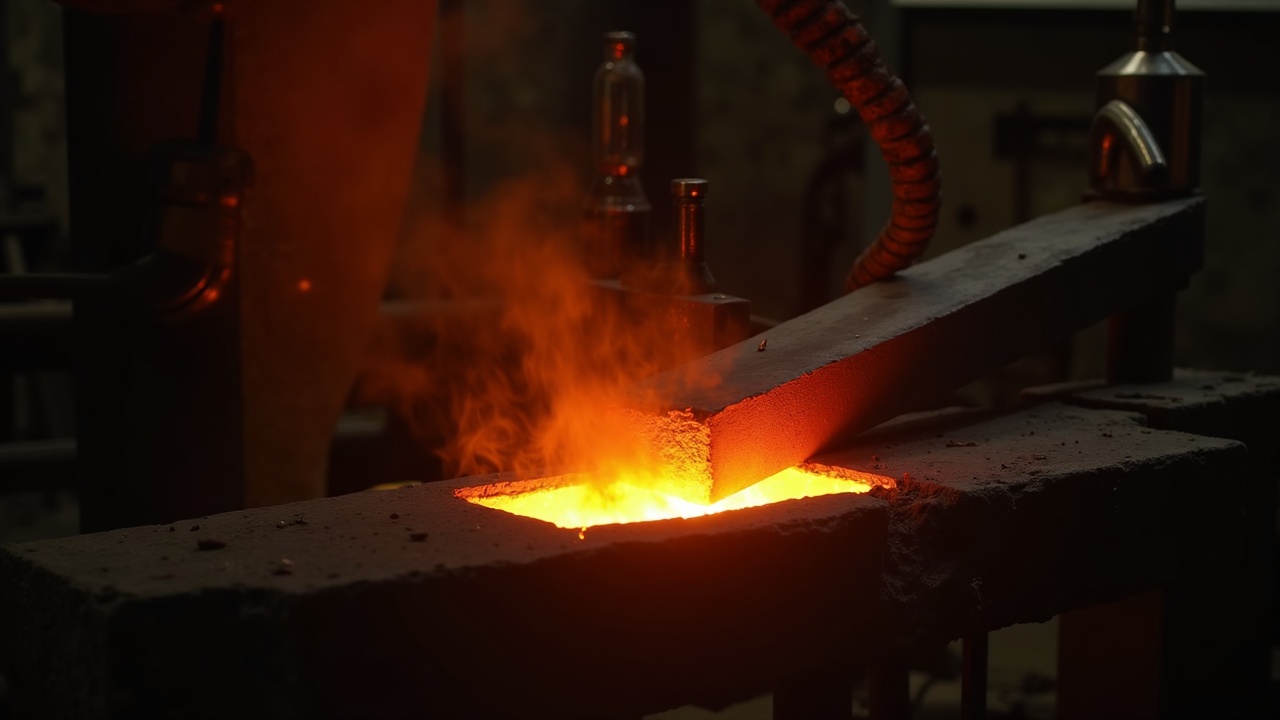
**Content Extraction Summary:** Comprehensive guide to heat treating carbon and alloy steels covering metallurgy fundamentals (iron-carbon phase diagram, critical temperatures, grain structure), all four primary heat treatment processes (annealing, normalizing, hardening, tempering), case hardening methods, complete heat treat recipes for 10 common steels with exact temperatures and soak times, equipment selection and DIY builds, and full troubleshooting diagnostics.
1. Introduction
Most blacksmiths and fabricators treat heat treating like black magic. It is not. It is applied metallurgy with a 3,000-year track record. The difference between a $2 piece of mild steel and a $200 knife blade is controlled heating and cooling — nothing else.
Steel is an alloy of iron and carbon. Carbon content ranges from 0.05% to 2.1% by weight. Below 0.05% you have wrought iron. Above 2.1% you have cast iron. Everything between is steel, and the carbon percentage determines nearly every mechanical property that matters: hardness, toughness, wear resistance, machinability.
Heat treating is the deliberate manipulation of steel's internal crystal structure through controlled heating and cooling cycles. Four primary processes exist: annealing (softening), normalizing (grain refinement), hardening (forming martensite), and tempering (trading hardness for toughness). Each one rearranges the same atoms into different configurations with radically different properties.
The iron-carbon phase diagram is the map. Every temperature, every hold time, every quench decision traces back to this single chart. Learn to read it and heat treating stops being guesswork.
The payoff is direct. A blacksmith who understands these processes can take commodity steel — a truck spring, a ball bearing race, a piece of drill rod — and produce tools that outperform factory equivalents. Not because the steel is special. Because the heat treat is right.
2. Metallurgy Basics
The Iron-Carbon Phase Diagram
This diagram plots temperature (vertical axis) against carbon content (horizontal axis) and shows which crystal structures are stable at any combination. Five structures matter:
**Ferrite (alpha iron).** Body-centered cubic (BCC) crystal. Soft, ductile, magnetic. Exists below 1,674°F (912°C) in low-carbon steels. Can dissolve only 0.022% carbon at maximum — essentially pure iron. This is the soft phase you feel when annealed steel machines easily.
**Austenite (gamma iron).** Face-centered cubic (FCC) crystal. Non-magnetic. Exists above the A1 temperature (1,333°F / 723°C). Can dissolve up to 2.1% carbon. This is the critical phase — all hardening depends on first achieving full austenite. When you heat steel to "critical temperature," you are converting ferrite to austenite.
**Pearlite.** A layered microstructure of alternating ferrite and cementite plates. Forms during slow cooling from austenite. Named because it has a pearly sheen under a microscope. Moderate hardness (~20 HRC), good machinability. This is what you get from normalizing.
**Martensite.** Body-centered tetragonal (BCT) crystal. Extremely hard (60-67 HRC), brittle. Forms only when austenite is cooled fast enough to trap carbon atoms in the iron lattice before they can diffuse out. This is the entire point of quenching. Martensite does not appear on the equilibrium phase diagram because it is a non-equilibrium structure — it forms only through rapid cooling (Verhoeven, 2007, pp. 134-137).
**Cementite (iron carbide, Fe₃C).** Hard, brittle compound containing 6.67% carbon by weight. Present in pearlite as thin plates. In hypereutectoid steels (above 0.76% carbon), excess cementite forms grain boundary networks that cause brittleness unless broken up through proper heat treatment.
Critical Temperatures
Three temperatures control every heat treat decision:
**A1 (lower critical, 1,333°F / 723°C).** Below this, austenite cannot exist. Above this, austenite begins forming. This is the eutectoid temperature — where pearlite transforms to austenite on heating and austenite transforms to pearlite on slow cooling.
**A3 (upper critical, varies with carbon content).** For hypoeutectoid steels (below 0.76% carbon), this is the temperature where transformation to austenite is complete. A3 decreases as carbon content increases, from about 1,674°F (912°C) at 0% carbon to 1,333°F (723°C) at 0.76% carbon. You must exceed A3 for full hardening.
**Acm (upper critical for hypereutectoid steels).** For steels above 0.76% carbon, this marks where excess cementite dissolves into austenite. Rises with increasing carbon content. Heating above Acm risks grain growth — most knifemakers intentionally stay between A1 and Acm for hypereutectoid steels like 1095.
Grain Structure
Steel is made of crystals called grains. Smaller grains produce tougher, stronger steel. Larger grains produce weaker, more brittle steel. The ASTM grain size number scale runs from 1 (very coarse, ~0.25 mm diameter) to 10 (very fine, ~0.01 mm diameter). Most properly heat-treated tool steels target ASTM 7-9.
Grain growth occurs when steel is held above A3 for too long or heated excessively above A3. Every time you overheat steel, grains merge and grow larger. The damage is cumulative but reversible — normalizing refines grain back down.
The Curie point (1,414°F / 768°C for carbon steel) is the temperature where steel loses its magnetism. A magnet held against heated steel will stop sticking at the Curie point. This is the single most useful shop-floor test for reaching hardening temperature, though it falls slightly below A3 for most steels, so a short additional soak is required after the magnet releases (ASM Handbook Vol. 4, pp. 18-19).
3. Annealing
Annealing softens steel by allowing carbon atoms to fully diffuse into their equilibrium positions. Four types serve different purposes.
Full Anneal
**Purpose:** Maximum softness. Produces coarse pearlite, the easiest structure to machine. Used when you need to drill, tap, saw, or file hardened or work-hardened steel.
**Process:** 1. Heat to 50°F (28°C) above A3 for hypoeutectoid steels, or 50°F above A1 for hypereutectoid steels 2. Soak 1 hour per inch of cross-section thickness 3. Cool in the furnace at no more than 50°F (28°C) per hour down to 1,000°F (538°C) 4. Air cool to room temperature after reaching 1,000°F
**Result:** Hardness drops to 15-20 HRC depending on carbon content. Full anneal is the slowest process — furnace cooling a thick section can take 8-12 hours. For most shop work, normalizing followed by a subcritical anneal achieves similar results in a fraction of the time.
Process Anneal (Subcritical Anneal)
**Purpose:** Relieves work hardening without full recrystallization. Used between cold-working operations — drawing wire, bending sheet, cold forging.
**Process:** 1. Heat to 1,000-1,200°F (538-649°C) — below A1 2. Soak 1 hour per inch 3. Air cool
**Result:** Restores ductility without changing grain structure. Faster than full anneal because you never enter the austenite range.
Spheroidize Anneal
**Purpose:** Produces the softest possible condition in high-carbon steels. Cementite plates in pearlite ball up into spheres (spheroidite), which makes the steel easier to cold form and machine.
**Process:** 1. Heat to just below A1 (1,300°F / 704°C) 2. Hold for 8-24 hours, or cycle above and below A1 repeatedly 3. Slow cool
**Result:** Hardness drops to 10-15 HRC. Spheroidize anneal is typically a mill operation for steels above 0.6% carbon before they ship to end users. If you buy O1 drill rod, it arrives spheroidize-annealed.
Stress Relief
**Purpose:** Removes residual stresses from welding, machining, grinding, or cold working without changing microstructure.
**Process:** 1. Heat to 900-1,100°F (482-593°C) 2. Soak 1 hour per inch 3. Slow cool in still air
**Result:** No change in hardness or grain structure. Essential after welding tool steel or after rough machining before final cuts — stress relief prevents warping during subsequent heat treatment.
4. Normalizing
Normalizing is the most underused process in the home shop. Most bladesmiths skip it. Most machinists have never heard of it. That is a mistake.
**Purpose:** Refine grain structure, homogenize carbon distribution, relieve internal stresses, and establish consistent mechanical properties throughout the workpiece. Normalizing is the reset button for steel.
**Why it matters.** Forged or hot-rolled steel has uneven grain sizes, banded carbide structures, and residual stresses from uneven cooling. These inconsistencies carry through into the final heat treat. Normalizing before hardening produces finer grain, more uniform hardness, and reduced warping during quench. Verhoeven's experimental work showed that three normalizing cycles reduced grain size by 2-3 ASTM numbers compared to direct hardening of as-forged steel (Verhoeven, 2007, pp. 196-199).
Process
1. Heat to 100-150°F (56-83°C) above A3 (or Acm for hypereutectoid steels) 2. Soak only until uniformly heated — shorter than annealing (roughly 10 minutes per inch) 3. Remove from heat and cool in still air
**Key distinction from annealing:** Normalizing uses air cooling. The faster cooling rate produces finer pearlite than furnace cooling, resulting in slightly higher hardness and strength but better toughness.
Thermal Cycling (Multiple Normalizations)
For forged blades and reclaimed steel, three normalizing cycles at progressively lower temperatures produce the best results:
1. **First cycle:** 1,550°F (843°C) — hot enough to dissolve all carbides and homogenize carbon distribution 2. **Second cycle:** 1,500°F (816°C) — further refines grain 3. **Third cycle:** 1,450°F (788°C) — produces the finest practical grain size
Each cycle creates new, smaller austenite grains that transform into correspondingly finer pearlite on air cooling. Three cycles is the practical optimum — additional cycles produce diminishing returns.
When to Normalize
- After forging, before hardening (always)
- After welding, before further heat treatment
- When reclaiming unknown steel from scrap
- After accidental overheating (grain growth)
- Before machining, if consistent machinability is needed across the piece
5. Hardening
Hardening converts pearlite to martensite through two steps: austenitizing (heating until the crystal structure transforms) and quenching (cooling fast enough to prevent carbon diffusion).
Austenitizing
**Temperature.** Heat 50°F (28°C) above A3 for hypoeutectoid steels. For hypereutectoid steels (1095, W2), heat to 1,450-1,475°F (788-802°C) — above A1 but below Acm. Exceeding Acm dissolves all cementite into austenite, which produces excess retained austenite after quench (reducing hardness) and promotes grain growth.
**Soak time.** Hold at temperature until the center of the workpiece reaches austenitizing temperature. Rule of thumb: 10-20 minutes per inch of thickness after the piece reaches target temperature. Thin blades (3/16" stock) need only 5-10 minutes of soak.
**Atmosphere.** Steel exposed to air above 1,400°F loses carbon from the surface (decarburization). The surface converts to soft ferrite that cannot harden. Prevention methods:
- Wrap in stainless steel foil
- Use an anti-scale compound (ATP-641 or similar)
- Heat in a controlled-atmosphere furnace
- Pack in cast iron chips or spent charcoal
Quench Media
The quench medium determines the cooling rate. Faster cooling produces harder martensite but increases the risk of cracking and warping. Choose the slowest quenchant that achieves full hardness for the steel in question.
**Brine (10% NaCl in water).** Fastest quench. Cooling rate approximately 400°F/second through the critical range. The salt disrupts the vapor blanket that normally forms around the workpiece, ensuring uniform cooling. Required for shallow-hardening steels like W1 in sections over 1/2 inch. High distortion and cracking risk.
**Water.** Fast quench, roughly 300°F/second. Used for W-series and plain carbon steels in thin sections. Agitate vigorously — still water produces vapor pockets that cause soft spots and uneven hardening.
**Oil (commercial quench oil, parks #50, canola oil).** Medium quench, roughly 100-150°F/second. Used for O1, 5160, and most alloy steels. Oil temperature matters: cold oil (60-80°F) quenches faster than warm oil (120-140°F). Parks #50 is the standard commercial fast quench oil. Canola oil is an acceptable budget substitute at similar speeds.
**Air.** Slow quench. Used for air-hardening steels (A2, D2, S7). The workpiece is removed from the furnace and cooled in still air or with a gentle fan. These steels contain enough alloying elements (chromium, molybdenum) to delay pearlite formation, allowing martensite to form even at slow cooling rates.
TTT Diagrams Simplified
Time-Temperature-Transformation (TTT) diagrams plot cooling curves against microstructure formation. The "nose" of the TTT curve is the critical feature — it represents the temperature range where pearlite forms fastest. Your quench must pass through this temperature range (typically 900-1,100°F / 482-593°C) faster than the nose time, or you get pearlite instead of martensite.
For plain carbon steels (1080, 1095, W1), the nose sits at about 1 second — you need an extremely fast quench. For alloy steels (4140, 5160), alloying elements push the nose to the right (longer times), making them easier to harden. For air-hardening steels (A2, D2), the nose sits at minutes or hours, meaning even still air is fast enough.
**Hardenability** is the depth to which martensite forms during quench. Shallow-hardening steels (W1, 1095) may only harden 1/8-1/4 inch deep in oil. Deep-hardening steels (O1, 4140) harden through their full cross-section. The Jominy end-quench test is the standard measurement (ASM Handbook Vol. 4, pp. 87-92).
Quench Procedure
1. Heat to austenitizing temperature, confirm with magnet test (magnet releases at Curie point, then soak an additional 50-100°F above) 2. Move quickly from furnace to quench tank — total transfer time under 3 seconds 3. Plunge straight in, tip first for blades, edge down for flat parts 4. Agitate the part in the quenchant — move it in a figure-eight pattern 5. Keep submerged until the part stops hissing (typically 10-30 seconds depending on mass and quenchant) 6. Test with a file — a properly hardened piece will glass off the file with no bite 7. Temper immediately — never let hardened steel sit overnight before tempering. The internal stresses from quenching can cause spontaneous cracking
6. Tempering
As-quenched martensite is as hard as the steel will ever get. It is also dangerously brittle — a hardened blade dropped on concrete can shatter. Tempering trades hardness for toughness by heating the martensite to a controlled temperature below A1 and holding it.
The Mechanism
Martensite is a supersaturated solution of carbon in iron. The carbon atoms are trapped in the wrong positions, distorting the crystal lattice and creating enormous internal strain. Tempering allows carbon atoms to migrate out of the martensite lattice and form tiny carbide particles. This relieves internal stress, reduces hardness, and dramatically increases toughness.
Higher tempering temperatures produce softer, tougher steel. Lower tempering temperatures retain more hardness but less toughness. The correct temper depends on the application.
Temper Color Chart
When polished steel is heated in air, a thin oxide layer forms that produces interference colors. These colors correspond to specific temperatures and serve as a visual guide for hand tempering (though an oven is more precise):
| Color | Temperature °F (°C) | Approximate HRC (1095) | Typical Application | |-------|---------------------|------------------------|---------------------| | Pale straw | 400°F (204°C) | 63-64 | Razors, engraving tools | | Light straw | 430°F (221°C) | 61-62 | Lathe tools, scrapers | | Dark straw | 450°F (232°C) | 59-60 | Plane blades, chisels (light duty) | | Gold/amber | 470°F (243°C) | 57-58 | Drill bits, taps, punches | | Bronze | 490°F (254°C) | 55-56 | Axes, wood chisels | | Purple | 520°F (271°C) | 52-54 | Knives (general purpose), cold chisels | | Violet | 540°F (282°C) | 50-52 | Swords, springs | | Dark blue | 570°F (299°C) | 48-50 | Springs, screwdrivers | | Light blue | 600°F (316°C) | 45-47 | Springs, saws | | Gray-blue | 640°F (338°C) | 40-43 | Structural springs |
Temper Procedure
1. Polish a spot on the hardened steel to bare metal (for color observation) 2. Place in oven preheated to target temperature 3. Soak for 1 hour per inch of cross-section, minimum 1 hour 4. Remove and air cool 5. For critical applications, repeat the cycle (double temper)
Double Tempering
High-alloy steels (D2, A2, S7, high-speed steels) contain retained austenite after quenching — austenite that did not transform to martensite. During the first temper, some retained austenite transforms to fresh, untempered martensite. A second temper cycle tempers this newly formed martensite.
Double tempering is essential for:
- Any steel containing more than 2% total alloying elements
- Any application requiring maximum toughness (dies, punches, impact tools)
- D2 and A2 specifically require double or triple tempering at 900-1,000°F
Temper Embrittlement
**Tempered martensite embrittlement (TME)** occurs in the 500-700°F (260-370°C) range for many steels. Toughness actually decreases instead of increasing at these temperatures. Avoid tempering in this range unless the specific steel's data sheet shows no TME susceptibility.
**Temper embrittlement (TE)** occurs in alloy steels when slow-cooled through the 700-1,000°F (370-538°C) range. Prevention: air cool or water quench from temper temperature instead of furnace cooling (ASM Handbook Vol. 4, pp. 133-136).
7. Case Hardening
Case hardening produces a hard, wear-resistant surface over a tough, shock-resistant core. Used when the entire cross-section does not need to be hard — gears, pins, shafts, camshafts.
Carburizing
**Principle.** Low-carbon steel (1018, 1020, 8620) is heated in a carbon-rich atmosphere above A3 (1,650-1,750°F / 900-954°C). Carbon diffuses into the surface, raising the carbon content of the outer layer to 0.7-0.9%. The carburized layer is then hardened by quenching.
**Pack carburizing (DIY method).** 1. Pack the part in a sealed steel box with activated charcoal granules mixed with 10-15% barium carbonate (BaCO₃) as an energizer 2. Seal the box with fireclay or furnace cement 3. Heat to 1,700°F (927°C) and hold 4. Case depth depends on time: ~0.010" per hour at 1,700°F. For a 0.030" case, hold 3 hours 5. Quench the part directly from the box into oil 6. Temper at 300-350°F (149-177°C)
**Result:** Surface hardness of 58-62 HRC over a core of 20-30 HRC. The transition zone is gradual.
Nitriding
**Principle.** Steel is heated to 950-1,050°F (510-566°C) in an ammonia atmosphere. Nitrogen diffuses into the surface and forms extremely hard iron nitride compounds. No quench required — the part is cooled slowly from nitriding temperature.
**Advantages over carburizing:** Lower temperature means less distortion. Case hardness reaches 65-70 HRC (harder than carburized cases). No quench means no cracking risk. Best used on alloy steels containing aluminum, chromium, or molybdenum (4140, Nitralloy 135).
**Limitation:** Case depths are shallow (0.010-0.025" typical) and process times are long (20-72 hours).
Pack Cementation (Kasenit / Cherry Red)
**The simplest case hardening method.** Heat the part to cherry red (1,400-1,500°F / 760-816°C), dip or roll in Kasenit compound (potassium ferrocyanide + carbon), reheat to cherry red, quench in water.
**Result:** Very thin case (0.005-0.010"), suitable for decorative items, small pins, and light-duty wear surfaces. Not suitable for high-stress applications. Kasenit is still available from blacksmithing suppliers.
8. Common Steels — Heat Treat Recipes
The following recipes represent standard shop practice for the 10 most commonly heat-treated steels. Temperatures are for conventional furnace heat treatment. All steels should be normalized before hardening unless otherwise noted.
1080 (0.80% Carbon — Eutectoid Steel)
| Step | Parameters | |------|-----------| | **Normalize** | 1,575°F (857°C), air cool | | **Harden** | 1,450-1,475°F (788-802°C), soak 10 min/inch | | **Quench** | Oil (parks #50 or canola) — water acceptable for thin sections | | **As-quenched** | 65 HRC | | **Temper** | 400°F (204°C) for knives (60-61 HRC), 500°F for springs (55-57 HRC) | | **Notes** | Eutectoid composition. Forgiving steel. Excellent for first-time heat treaters. Relatively tough at high hardness. |
1095 (0.95% Carbon — Hypereutectoid)
| Step | Parameters | |------|-----------| | **Normalize** | 1,550°F (843°C) × 3 cycles at 1,550/1,500/1,450°F, air cool | | **Harden** | 1,450-1,475°F (788-802°C), soak 10 min/inch | | **Quench** | Oil for blades under 3/16". Brine or fast water for thicker sections. | | **As-quenched** | 65-66 HRC | | **Temper** | 400°F (204°C) for knives (60-62 HRC), 475°F for choppers (57-58 HRC) | | **Notes** | The classic American knife steel. Shallow hardening in oil. Do NOT exceed Acm (1,525°F) — produces retained austenite and cementite networks. |
O1 (Oil-Hardening Tool Steel — 0.90% C, 1.0% Mn, 0.50% Cr, 0.50% W)
| Step | Parameters | |------|-----------| | **Normalize** | Not recommended by manufacturer — O1 is typically used in annealed condition from the mill | | **Harden** | 1,450-1,500°F (788-816°C), soak 15-20 min/inch | | **Quench** | Oil only. Warm oil (100-130°F / 38-54°C) reduces cracking risk. | | **As-quenched** | 63-65 HRC | | **Temper** | 400°F (204°C) for 63 HRC. 450°F for 60 HRC. Two temper cycles recommended. | | **Notes** | The best general-purpose tool steel for the home shop. Available as precision-ground drill rod (ground flat stock). Machines well in annealed condition. Excellent dimensional stability during heat treat. |
W1 (Water-Hardening Tool Steel — 0.60-1.40% C, varies by grade)
| Step | Parameters | |------|-----------| | **Normalize** | 1,500°F (816°C), air cool | | **Harden** | 1,425-1,475°F (774-802°C) depending on carbon content, soak 10 min/inch | | **Quench** | Water or brine. W1 is designed for water quench. Oil will NOT fully harden except in very thin sections. | | **As-quenched** | 65-67 HRC | | **Temper** | 350-400°F (177-204°C) for full hardness. 450°F for moderate toughness. | | **Notes** | Extremely shallow hardening — typically only 1/8-1/4" deep in sections over 1/2". The soft core acts as a built-in shock absorber. Traditional steel for chisels, punches, and hand tools. High cracking risk — preheat quench water to 65-75°F (18-24°C). |
W2 (Water-Hardening Tool Steel with Vanadium — 0.90-1.10% C, 0.20% V)
| Step | Parameters | |------|-----------| | **Normalize** | 1,550°F (843°C) × 3 cycles, air cool | | **Harden** | 1,425-1,475°F (774-802°C), soak 10 min/inch | | **Quench** | Water or brine. Parks #50 oil works for blades under 1/4" | | **As-quenched** | 65-67 HRC | | **Temper** | 400°F (204°C) for 62-63 HRC. 425°F for 60-61 HRC. | | **Notes** | The vanadium addition keeps grain fine during austenitizing. Produces excellent hamon (temper line) in water quench with clay coating. The preferred steel for Japanese-style kitchen knives among Western makers. |
5160 (Spring Steel — 0.60% C, 0.80% Cr, 0.20% Mo)
| Step | Parameters | |------|-----------| | **Normalize** | 1,600°F (871°C), air cool | | **Harden** | 1,500-1,525°F (816-829°C), soak 10 min/inch | | **Quench** | Oil (fast oil preferred). Not air-hardening despite chromium content. | | **As-quenched** | 60-63 HRC | | **Temper** | 400°F (204°C) for 58-59 HRC (heavy knives). 500°F for 54-55 HRC (swords, machetes). 700°F for springs (45-48 HRC). | | **Notes** | The toughest common knife steel. Standard for swords, large choppers, and impact tools. Deep hardening in oil — hardens through in sections up to 2". Used truck/automotive leaf springs are 5160 or equivalent. |
4140 (Chromium-Molybdenum — 0.40% C, 0.95% Cr, 0.20% Mo)
| Step | Parameters | |------|-----------| | **Normalize** | 1,600°F (871°C), air cool | | **Harden** | 1,525-1,575°F (829-857°C), soak 15 min/inch | | **Quench** | Oil. Can be water quenched in thin sections but with higher cracking risk. | | **As-quenched** | 55-58 HRC | | **Temper** | 400°F for 52-54 HRC. 600°F for 45-48 HRC (shafts, bolts). 800°F for 38-40 HRC (structural). | | **Notes** | Not a knife steel — insufficient carbon for high edge hardness. Excellent for tools, fixtures, shafts, axles, gears, and structural parts requiring moderate hardness and high toughness. Deep hardening. Widely available as hot-rolled round bar. Commonly used in hydraulic cylinder rods and drill collars. |
D2 (High-Carbon High-Chromium — 1.50% C, 12% Cr, 0.90% Mo, 0.80% V)
| Step | Parameters | |------|-----------| | **Normalize** | Not recommended — slow air cool from austenitizing to 1,000°F, then full air cool | | **Preheat** | Ramp to 1,200°F (649°C), hold 30 min, then ramp to hardening temperature | | **Harden** | 1,825-1,875°F (996-1,024°C), soak 30-45 min/inch | | **Quench** | Air cool (positive pressure/fan). D2 is air-hardening. Do NOT oil quench — cracking risk. | | **As-quenched** | 62-64 HRC | | **Temper** | Double temper at 400°F (204°C) for 60-61 HRC (knives). Triple temper at 950°F (510°C) for 58-59 HRC (dies). | | **Notes** | Semi-stainless (12% Cr, but carbides consume chromium so effective Cr in matrix is lower). Exceptional wear resistance. Poor toughness compared to simple carbon steels — not for impact or batoning. Difficult to sharpen. Requires a controlled furnace — cannot be reliably heat-treated with a forge. |
A2 (Air-Hardening — 1.00% C, 5.25% Cr, 1.10% Mo, 0.25% V)
| Step | Parameters | |------|-----------| | **Normalize** | Not recommended | | **Preheat** | Ramp to 1,200°F (649°C), hold until uniformly heated | | **Harden** | 1,750-1,800°F (954-982°C), soak 30 min/inch minimum | | **Quench** | Air cool. Place on a wire rack with free air circulation all around. Fan cooling acceptable but not forced air blast. | | **As-quenched** | 62-64 HRC | | **Temper** | Double temper at 400°F (204°C) for 60-61 HRC. Double temper at 500°F for 58-59 HRC. | | **Notes** | Better toughness than D2 at similar hardness. The standard punch and die steel. Excellent dimensional stability — the best choice for precision tools that cannot distort. Requires a kiln/oven with accurate temperature control above 1,750°F. |
S7 (Shock-Resistant Tool Steel — 0.50% C, 3.25% Cr, 1.40% Mo)
| Step | Parameters | |------|-----------| | **Normalize** | Not recommended | | **Preheat** | 1,200°F (649°C), hold until uniformly heated | | **Harden** | 1,700-1,750°F (927-954°C), soak 30 min/inch | | **Quench** | Air cool or oil quench. S7 is air-hardening but oil quench produces slightly higher hardness in heavy sections. | | **As-quenched** | 56-58 HRC (air), 58-60 HRC (oil) | | **Temper** | Double temper at 400°F (204°C) for 56-57 HRC. Double temper at 500°F for 53-54 HRC. | | **Notes** | The toughest tool steel commercially available. Designed for impact applications — pneumatic chisels, jackhammer bits, strike plates, forming dies. Will not chip or shatter under heavy impact where D2 or A2 would fail. Lower wear resistance is the trade-off. |
9. Equipment
Heat Source
**Coal or gas forge.** Adequate for simple carbon steels (1080, 1095, W1, W2, 5160). Cannot provide accurate temperature control above ±50°F. Acceptable for hardening and normalizing where the magnet test provides sufficient accuracy. Not suitable for air-hardening steels that require precise soak temperatures above 1,700°F.
**Electric kiln/oven with PID controller.** The correct tool for serious heat treating. A PID (Proportional-Integral-Derivative) controller reads a thermocouple and maintains temperature within ±5°F. Required for air-hardening tool steels, tempering, and any process where consistent results matter.
**Budget build.** A used pottery kiln ($100-300 on marketplace) with an aftermarket PID controller ($40-80) and K-type thermocouple ($15-25) produces results equivalent to commercial heat treat ovens costing $2,000+. Wire the PID controller to the kiln's relay and the thermocouple through the chamber wall. Total investment under $400 for a setup that handles every steel on this list.
**Tempering oven.** A standard kitchen oven works for tempering below 500°F. Above that, use the kiln or a dedicated toaster oven with an external thermometer (kitchen oven thermostats are inaccurate by ±25°F in many cases). Verify actual air temperature with an oven thermometer placed on the rack next to the workpiece.
Quench Tanks
**Minimum dimensions:** The quenchant volume should be at least 20 times the volume of the part being quenched. Insufficient volume causes the quenchant temperature to spike, slowing the quench and producing incomplete hardening.
**Construction:** A 5-gallon steel pail works for knives and small tools. For larger work, weld a tank from 1/8" steel plate — 8" × 8" × 24" deep is a versatile size. Tall and narrow is better than short and wide, so long parts can be quenched vertically.
**Oil quench tanks** should have a lid within reach in case the oil catches fire. Flash point for commercial quench oils is typically 300-400°F. Canola oil has a flash point around 450°F. Keep a class B fire extinguisher within arm's reach. Never quench into an open container sitting on a flammable surface.
Testing Equipment
**Magnet.** A rare-earth magnet on a wire handle is the single most useful heat-treating tool. Hold it against the heated steel — when it releases, you have reached the Curie point (1,414°F). Soak for an additional few minutes to reach the target austenitizing temperature.
**File test.** A new, sharp file skates across properly hardened high-carbon steel with zero bite. If the file cuts, the part is not fully hardened. This test is free, immediate, and surprisingly reliable for simple carbon steels. Accuracy degrades with lower-carbon or alloy steels that achieve lower as-quenched hardness.
**Rockwell hardness tester.** The definitive test. A Rockwell C (HRC) tester uses a diamond cone indenter under a 150 kg load. Bench-mounted testers run $300-800 used. Digital portable testers (Leeb-type) run $150-300 and provide reasonable accuracy (±2 HRC) on flat surfaces. If you heat treat professionally, a Rockwell tester is essential.
10. Troubleshooting
Warping
**Cause:** Uneven heating, uneven quenching, or uneven cross-section geometry. One side cools faster than the other, contracting first and pulling the piece out of shape.
**Prevention:**
- Heat slowly and evenly — rotate the piece in the furnace
- Quench vertically (spine down for blades) to equalize cooling
- Normalize before hardening to relieve pre-existing stresses
- Use the slowest quenchant that achieves full hardness
- Design parts with uniform cross-sections where possible
**Fix:** Minor warps can be straightened during temper. Heat to tempering temperature, clamp straight in a vise or fixture, and allow to cool under constraint.
Cracking
**Cause:** Thermal shock from too-fast quenching, sharp internal corners acting as stress risers, quenching too cold, or failing to temper immediately after quench.
**Prevention:**
- Round all internal corners (minimum 1/16" radius)
- Use oil quench instead of water where the steel allows it
- Preheat the quenchant to 70-130°F depending on the medium
- Temper within 1 hour of quenching — within 15 minutes for high-alloy steels
- Never quench a part with drilled holes, sharp notches, or abrupt section changes without stress-relief first
**Fix:** None. Cracks cannot be welded in hardened steel without destroying the heat treat. Start over.
Soft Spots
**Cause:** Vapor pockets during quench (the quenchant boils and creates an insulating steam jacket), insufficient quenchant agitation, scale or oxide on the surface, or incomplete austenitizing.
**Prevention:**
- Agitate the part vigorously during quench
- Add 10% salt to water quench (brine) — salt disrupts the vapor blanket
- Remove all scale before quenching (wire brush at heat)
- Ensure the entire part reaches austenitizing temperature before quenching
Decarburization
**Cause:** Carbon at the steel surface reacts with oxygen in the air at temperatures above 1,400°F, forming CO and CO₂. The surface layer loses carbon and cannot harden. Appears as a soft, gray skin after quenching.
**Prevention:**
- Minimize time at austenitizing temperature (do not over-soak)
- Wrap in stainless steel foil with a charcoal briquette chip inside (consumes oxygen)
- Apply anti-scale compound before heating
- Leave 0.010-0.020" of grinding stock and remove the decarburized layer after hardening
**Detection:** File test — a decarburized surface files easily even though the interior is fully hard. Grind below the decarburized layer and re-test.
Grain Growth
**Cause:** Heating significantly above A3 or holding at austenitizing temperature for too long. Grains merge and grow, producing coarse, weak, brittle steel. Visible on a fractured surface as a sparkly, faceted appearance instead of a fine, silky, dull gray fracture.
**Prevention:**
- Never exceed the recommended austenitizing temperature
- Use the minimum soak time necessary for through-heating
- If grain growth occurs, normalize three times at decreasing temperatures to restore fine grain
**Fix:** Three normalizing cycles. If the steel was severely overheated (above 1,700°F for simple carbon steels), add a fourth cycle.
11. Sources
1. Verhoeven, John D. *Steel Metallurgy for the Non-Metallurgist*. ASM International, 2007. The single best text for practical heat treaters without a materials science degree. Covers phase diagrams, martensite formation, quenching theory, and specific steel recommendations.
2. ASM International. *ASM Handbook, Volume 4: Heat Treating*. ASM International, 1991. The professional reference standard. Contains TTT and CCT diagrams, full heat treat specifications, and data for hundreds of steel grades.
3. Verhoeven, John D. "A Review of Microsegregation Induced Banding Phenomena in Steels." *Journal of Materials Engineering and Performance*, Vol. 9, No. 3, 2000, pp. 289-296.
4. Krauss, George. *Steels: Processing, Structure, and Performance*. ASM International, 2005. Advanced metallurgy text covering tempering mechanisms, retained austenite transformation, and the physical basis of hardenability.
5. Barker, David M. and Totten, George E. "Quenching Fundamentals." *Heat Treating Progress*, ASM International, May/June 2002, pp. 37-43.
6. AISI/SAE Steel Grade Standards. Steel specifications for all grades listed (1080, 1095, O1, W1, W2, 5160, 4140, D2, A2, S7).
`[practical-skills]` `[advanced]`