guides
Santa Rosa Plum (Prunus salicina ‘Santa Rosa’): Cultivation & Fruit Profile Guide
Guide to Santa Rosa plum cultivation covering Prunus salicina botany, fruit characteristics, growing parameters, climate adaptation, soil requirements.
Botanical Description and Modern Scientific Context
Santa Rosa plum is a classic Japanese-type plum cultivar (Prunus salicina) developed in the early 20th century and widely regarded as one of the foundational modern dessert plums. The tree is deciduous, moderately vigorous, and typically reaches 12–20 feet (3.5–6 m) in height when mature, with an open, spreading canopy and strong lateral branching.
Developed by the renowned horticulturist Luther Burbank around 1906 in Santa Rosa, California, this cultivar was selected from crosses involving Japanese plum germplasm and has since served as both a commercial production standard and a parent in numerous subsequent breeding programs. Its widespread adoption across temperate stone fruit regions reflects its reliable performance, attractive appearance, and distinctive flavor profile.
Taxonomic Classification
Prunus salicina belongs to the family Rosaceae, subfamily Amygdaloideae. Unlike European plums (Prunus domestica), Japanese-type plums are diploid (2n = 16), generally bloom earlier in spring, and produce fruit with higher juice content and a more pronounced sugar-acid balance. Santa Rosa remains one of the most widely planted P. salicina cultivars worldwide.
Tree Morphology
| Parameter | Specification |
|---|---|
| Mature Height | 12–20 ft (3.5–6 m) |
| Canopy Form | Open, spreading with strong lateral branching |
| Growth Habit | Deciduous, moderately vigorous |
| Bark | Smooth gray-brown when young, developing shallow fissures with age |
| Leaves | Alternate, oblong-lanceolate, 5–10 cm, finely serrated margins |
| Flowers | White, 5-petaled, appearing before or with leaf emergence |
Fruit Characteristics and Quality Profile
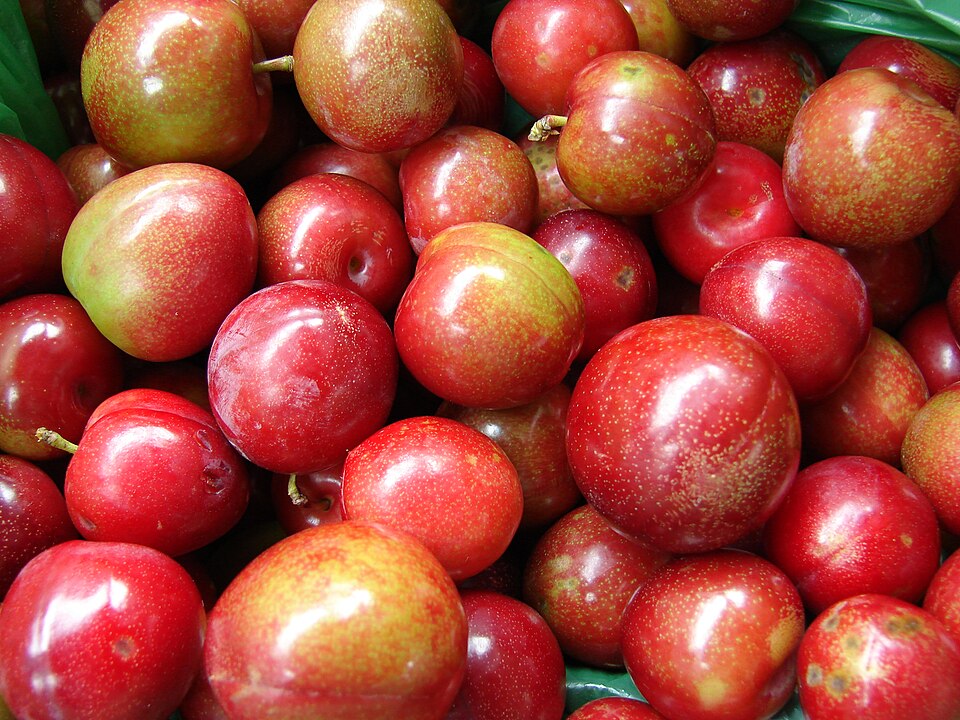
The fruit is medium to large, round to slightly heart-shaped, with deep reddish-purple skin and amber to yellow flesh often blushed red near the pit. Flesh texture is juicy and tender, with a balance of sugars and organic acids that gives Santa Rosa its distinctive sweet-tart flavor profile—a quality that has made it a benchmark cultivar in fresh-market plum evaluation.
Fruit Specifications
| Parameter | Value |
|---|---|
| Fruit Size | Medium to large (5–7 cm diameter) |
| Fruit Shape | Round to slightly heart-shaped (cordate) |
| Skin Color | Deep reddish-purple with waxy bloom |
| Flesh Color | Amber to yellow, blushed red near pit |
| Flesh Texture | Juicy, tender, moderately firm |
| Flavor Profile | Sweet-tart with aromatic complexity |
| Stone | Clingstone to semi-freestone |
| Soluble Solids | 14–18 °Brix at maturity |
The skin develops a characteristic waxy bloom as the fruit approaches maturity, contributing to both post-harvest longevity and visual appeal. Anthocyanin accumulation in the skin—primarily cyanidin-3-glucoside and cyanidin-3-rutinoside—is responsible for the deep purple coloration and contributes to the fruit’s antioxidant profile.
Phytochemical Profile
Japanese plums, including Santa Rosa, contain notable concentrations of phenolic acids (chlorogenic acid, neochlorogenic acid), flavonols (quercetin glycosides), and anthocyanins concentrated primarily in the skin. These compounds are studied in the context of oxidative stress modulation and general dietary polyphenol research, not as therapeutic agents.
Climate Requirements and Environmental Parameters
Santa Rosa plum is well adapted to USDA hardiness zones 5–9 and thrives in Mediterranean, subtropical, and warm-temperate climates. It requires a moderate chilling period to break dormancy but is notably lower in chill requirement than most European plum cultivars, making it suitable for regions with mild winters.
| Parameter | Optimal Range |
|---|---|
| USDA Hardiness Zones | 5–9 |
| Chilling Requirement | 400–500 hours below 7°C (45°F) |
| Growing Season Temperature | 20–32°C (68–90°F) |
| Bloom Period | Early spring (susceptible to late frosts) |
| Sun Exposure | Full sun (minimum 6–8 hours direct) |
| Annual Rainfall | 20–35 in (500–900 mm), supplemental irrigation in dry climates |
| Frost Sensitivity | High during bloom; flowers damaged below -2°C (28°F) |
Early Bloom Hazard
Because Japanese plums bloom earlier than European types, Santa Rosa is particularly vulnerable to late spring frosts. Site selection on elevated ground or near thermal masses (buildings, walls, bodies of water) can mitigate frost damage during the critical bloom window.
Soil Characteristics and Nutrient Requirements
Santa Rosa plum performs best in well-drained, moderately fertile loam or sandy loam soils with a pH range of 5.5–6.5. The species is notably intolerant of waterlogged or heavy clay soils, which promote root diseases, particularly Phytophthora root rot.
Soil Parameters
| Parameter | Optimal Range |
|---|---|
| Soil pH | 5.5–6.5 |
| Soil Type | Well-drained loam or sandy loam |
| Organic Matter | 2–5% recommended |
| Drainage | Essential; intolerant of waterlogging |
Nutrient Management
Nitrogen is the primary nutrient driving vegetative growth and fruit development. Mature trees typically require 60–100 lb N/acre annually, applied in split applications—early spring and post-harvest. Excessive nitrogen promotes vegetative growth at the expense of fruit quality and increases susceptibility to bacterial canker.
- Nitrogen (N): 60–100 lb/acre; split applications in spring and post-harvest
- Phosphorus (P): Moderate; based on soil test results, primarily supports root development
- Potassium (K): Important for fruit size, sugar accumulation, and winter hardiness
- Calcium (Ca): Supports cell wall integrity and reduces post-harvest fruit disorders
- Zinc (Zn) & Boron (B): Common micronutrient deficiencies in stone fruit; monitor via foliar analysis
Pollination and Fruit Set
Santa Rosa is partially self-fertile, meaning it can set some fruit without a cross-pollinator. However, fruit set, size, and overall yield are significantly improved when a compatible pollinator variety is planted within 50–100 feet (15–30 m).
Recommended Pollinizers
- Beauty: Early-blooming Japanese plum; strong overlap with Santa Rosa bloom period
- Burgundy: Reliable cross-pollinator with compatible bloom timing
- Mariposa: Mid-season bloom; extends effective pollination window
- Late Santa Rosa: Sport of Santa Rosa with later ripening; compatible pollen source
Pollination Note
European plums (Prunus domestica) are generally not effective pollinizers for Japanese types (P. salicina) due to differences in ploidy and bloom timing. Select pollinizer cultivars from within the Japanese plum group for reliable cross-pollination.
Planting, Spacing, and Structural Management
Santa Rosa plum is typically planted as a bare-root or container-grown tree during the dormant season (late winter to early spring). Proper spacing and training during the first 3–4 years establishes the structural framework for long-term productivity.
| Parameter | Specification |
|---|---|
| Planting Season | Late winter to early spring (dormant) |
| Spacing (Standard Rootstock) | 18–22 ft (5.5–6.7 m) between trees |
| Spacing (Semi-Dwarf Rootstock) | 12–16 ft (3.7–4.9 m) between trees |
| Training System | Open-center (vase) preferred |
| Years to First Fruit | 3–4 years from planting |
| Full Production | 5–7 years from planting |
Pruning Principles
Japanese plums fruit primarily on one-year-old wood and short spurs on older wood. Annual dormant pruning should focus on:
- Maintaining an open-center canopy for light penetration and air circulation
- Removing dead, diseased, or crossing branches
- Thinning excess fruiting wood to prevent overbearing and branch breakage
- Heading back vigorous shoots to encourage lateral branching and spur development
Summer thinning of fruit clusters to 4–6 inch (10–15 cm) spacing improves individual fruit size, sugar concentration, and reduces alternate-bearing tendencies.
Harvest Timing and Quality Indicators
Santa Rosa plum typically ripens from late June through mid-July in most growing regions, approximately 60–80 days after full bloom. Harvest timing is critical because the fruit develops its distinctive flavor only during the final stages of ripening.
- Skin color transitions from red-purple to deep, uniform reddish-purple
- Flesh yields slightly to gentle pressure at the shoulder
- Soluble solids reach 14–18 °Brix
- Background color shifts from green to yellow-amber
- Aromatic intensity increases noticeably at the stem end
Harvest Window
Santa Rosa has a relatively narrow harvest window of 7–14 days. Fruit picked too early lacks sweetness and aromatic complexity; fruit left too long becomes soft and susceptible to cracking, brown rot (Monilinia fructicola), and insect damage. Multiple selective harvests over the ripening period optimize overall fruit quality.
Post-Harvest Handling and Storage
Plums are climacteric fruit and continue to ripen after harvest. Proper post-harvest management extends shelf life while preserving flavor and texture.
| Method | Conditions | Shelf Life |
|---|---|---|
| Cold Storage | 0–1°C (32–34°F), 90–95% RH | 2–4 weeks |
| Room Temperature | 20–22°C (68–72°F) | 3–5 days |
| Freezing | Halved, pitted, at -18°C (0°F) | 8–12 months |
| Drying / Dehydration | 55–60°C (130–140°F) | 6–12 months (sealed) |
Internal breakdown and chilling injury can occur during extended cold storage below 5°C (41°F), manifesting as flesh browning, mealiness, or loss of flavor. A brief warming period of 24–48 hours at 20°C before consumption can partially restore flavor and texture in cold-stored fruit.
Culinary Use and Processing Applications
Santa Rosa’s sweet-tart flavor and juicy texture make it exceptionally versatile for both fresh consumption and culinary processing.
- Fresh eating: Peak quality at full ripeness with balanced sugar-acid ratio
- Jams & preserves: Natural pectin content supports gel formation with moderate sugar addition
- Baking: Holds shape reasonably well in tarts, galettes, and crisps
- Sauces & chutneys: Acid content complements savory pairings (poultry, pork)
- Fermentation: Traditional plum wine and brandy production; suitable for lacto-fermentation
- Drying: Can be dried into prunes, though European plums are traditionally preferred for this purpose
Skin Pigment in Processing
The anthocyanin-rich skin imparts a deep ruby color to jams, syrups, and fermented preparations. Retaining the skin during processing maximizes both color intensity and polyphenol content in the finished product.
Common Pests and Disease Considerations
Santa Rosa plum is susceptible to several pests and diseases common to stone fruit in temperate climates. Integrated pest management (IPM) strategies are preferred over calendar-based chemical applications.
Key Disease Concerns
- Brown rot (Monilinia fructicola): Most significant disease; affects blossoms, twigs, and ripening fruit. Managed through sanitation, airflow, and timely fungicide applications
- Bacterial canker (Pseudomonas syringae): Causes gumming, branch dieback; avoid pruning during wet weather
- Plum leaf curl (Taphrina deformans): Dormant-season copper applications provide effective prevention
- Black knot (Apiosporina morbosa): Prune and destroy infected wood promptly
Key Pest Concerns
- Plum curculio (Conotrachelus nenuphar): Major fruit pest in eastern growing regions; causes crescent-shaped scars
- Oriental fruit moth (Grapholita molesta): Larvae bore into developing fruit and shoots
- Aphids: Can distort new growth and transmit viral diseases; managed with beneficial insect habitat
- Birds: Netting or deterrents may be necessary as fruit ripens
Scientific and Authoritative References
This article is informed by data and conclusions drawn from, but not limited to:
- Okie, W.R. & Ramming, D.W., Plum Breeding Worldwide, HortTechnology
- Crisosto, C.H. et al., Postharvest Quality of Plum and Prune Cultivars, HortScience
- USDA Plant Guide: Prunus salicina Lindl.
- Faust, M. & Suranyi, D., Origin and Dissemination of Plums, Horticultural Reviews
- Topp, B.L. et al., Fruit Breeding: Japanese Plum, Handbook of Plant Breeding
- Gil, M.I. et al., Antioxidant Capacities, Phenolic Compounds, and Vitamin C Contents of Plum Cultivars, Journal of Agricultural and Food Chemistry
- University of California, Davis, Integrated Pest Management for Stone Fruits
- Breen, P.J., Prunus salicina Cultivar Descriptions, Oregon State University Extension
- Hartmann, H.T. et al., Plant Propagation: Principles and Practices, 8th ed.
- Westwood, M.N., Temperate-Zone Pomology: Physiology and Culture, Timber Press