plants
Season Extension
Extend the growing season: cold frames, floating row cover, low tunnels, and hoop houses to grow earlier, later, and through winter.
Content Extraction Summary
Hook Options
On clear nights, radiant cooling causes plant surface temperatures to fall 2–5 degrees below ambient air temperature — a night that a thermometer reads as 34°F can kill frost-sensitive plants through radiant surface cooling that brings leaf surfaces to 28 or 29°F. A cold frame fails most often not from cold but from heat — on a sunny winter day with ambient air at 35°F, the interior of a closed frame in direct sun can reach 80–100°F within hours, stress-cooking everything inside. A double-layer hoop house built for $400 in materials can generate $3,000–$6,000 in additional annual revenue for a market gardener by extending the season 6–8 weeks in spring and 8–10 weeks in fall and winter.
Key Mechanism
Inflating the air gap between two layers of poly film on a hoop house using a continuously running small fan creates a dead-air insulation layer that approximately doubles nighttime heat retention compared to a single-layer structure. A double-layer hoop house in Zone 6 maintains temperatures above 28°F on nights down to 10–15°F outside — without any supplemental heat — making winter production of hardy greens viable through the full season.
Misconception to Correct
Most growers assume row cover should be applied after a frost event hits to protect damaged plants. Deploying cover before a frost event is what actually works — it traps the warm air around the plants before it escapes overnight, and cover applied after temperatures have already dropped provides little benefit.
Practical Application
Fit automated wax-cylinder vent openers to cold frame lids — they open mechanically at a preset interior temperature without electricity, preventing the routine overheating that kills cold-frame crops when the grower cannot check the frame on every sunny day.
Citation-Ready Claims
- [Radiant cooling on clear nights] → [Plant surface temperatures fall 2–5°F below ambient air temperature] → [Micrometeorology / agricultural frost study needed]
- [Double-layer hoop house (Zone 6)] → [Maintains above 28°F on nights down to 10–15°F outside without supplemental heat] → [Season extension performance study needed]
- [Double-layer vs. single-layer hoop house] → [Approximately doubles nighttime heat retention] → [Greenhouse engineering / thermal performance study needed]
- [Heavy row cover (1.5 oz)] → [Provides 4–8°F of frost protection; transmits 70–80% of light] → [Row cover manufacturer spec / extension trial needed]
Cold Frames, Row Cover, Low Tunnels, and Hoop Houses
*Pure Euphoria Botanicals • Nored Farms • Austin, Texas*
Introduction
The last frost date is not a wall. It is a statistical average, and the growing season does not begin and end at those averages — it begins and ends when a grower decides to push against them. Season extension tools work by creating a microclimate around the crop that is a few degrees warmer than ambient air, and a few degrees is all the difference between a living plant and a dead one on the majority of nights when frost threatens in early spring and late fall.
The economics of season extension are among the most favorable of any garden investment. A roll of floating row cover that costs $30 can protect a full season's planting of transplants through a late spring frost event. A $50 cold frame built from scavenged windows can produce fresh salad greens through December in Zone 6. An unheated hoop house built for $200 in materials can extend a market garden's production by 8–10 weeks on each end of the season and make a meaningful difference to a farm's annual income. The returns are immediate, reliable, and compounding.
Part I: Understanding What Season Extension Actually Does
Temperature management is the core function. Most damage to plants from cold comes not from the air temperature at 5 feet above the ground (which is what weather services report) but from the surface temperature of leaves and the soil surrounding roots. Radiant cooling on clear nights causes plant surface temperatures to fall 2–5 degrees below ambient air temperature. A night that a thermometer reads as 34 degrees can kill frost-sensitive plants through radiant surface cooling that brings leaf temperatures to 28 or 29 degrees.
Season extension structures interrupt this process. Row cover and tunnels trap outgoing infrared radiation and create a small air pocket that moderates surface cooling. Cold frames and hoop houses do the same at a larger scale, also capturing and storing daytime solar energy in the enclosed air and in any thermal mass present. The more thermal mass in the structure and the better the insulation of the covering material, the larger the temperature buffer and the more extreme the overnight low temperatures the structure can withstand.
Season Extension Structure Comparison
| Structure | Temperature Gain Over Ambient | Season Extension | Cost Range (DIY) | Key Management | |---|---|---|---|---| | Lightweight row cover (0.55 oz) | +2 to 4°F | 2–3 weeks each end | $0.05–0.15/sq ft | Remove during warm days; weight on edges to seal | | Heavy row cover (1.5 oz) | +4 to 8°F | 3–5 weeks each end | $0.10–0.20/sq ft | Reduces light 15–20%; remove when temps allow | | Low tunnel (wire + poly film) | +8 to 15°F on clear nights | 4–6 weeks each end | $0.15–0.50/sq ft | Vent daily when above 40°F outside | | Cold frame (glass or poly lid) | +10 to 25°F (solar gain) | 6–10 weeks each end; winter production in mild zones | $20–200 per frame | Critical: must ventilate on sunny days; overheats rapidly | | Unheated hoop house (single layer) | +10 to 18°F over ambient | 6–10 weeks each end | $0.50–1.50/sq ft | Roll-up sides; active ventilation in summer | | Double-layer hoop house | +15 to 25°F over ambient | 8–14 weeks each end; winter production in Zone 6+ | $1.00–2.50/sq ft | Inflation fan for air gap; highest passive performance |
Part II: Floating Row Cover
Floating row cover is the most versatile and cost-effective season extension tool available. It is a spunbonded polyester fabric that allows light, water, and air to pass through while trapping enough heat to provide meaningful frost protection. It can be laid directly on plants without support hoops, draped over wire or PVC hoops, or used as a top cover on cold frames.
The two most important variables are weight and deployment timing. Lightweight covers (0.55 oz per square yard) transmit 85–90 percent of available light and provide 2–4 degrees of frost protection. Heavy covers (1.5–2.0 oz) provide 4–8 degrees of protection but transmit 70–80 percent of light — adequate for overwintering low-light crops but limiting for high-light crops in short winter days. Deploying cover before a frost event rather than after ensures that the warm air around the plants is trapped before it escapes overnight.
- **Spring use:** Lay over transplants immediately after planting to protect from late frost events and to accelerate early establishment
- **Fall use:** Deploy at first frost forecast to extend warm-season crops; a 3–4 degree buffer can add 2–3 weeks of tomato and pepper production after the first frost event of fall
- **Pest barrier use:** Row cover used during peak aphid and whitefly flight periods prevents colonization without any chemical input; remove during flowering to allow pollination
- **Securing edges:** Use soil, rocks, landscape pins, or sandbags to seal the edges to the ground; any gap allows cold air infiltration that defeats the purpose of the cover
Part III: Cold Frames
A cold frame is an unheated box with a transparent lid. The walls contain the warmth of the enclosed air and provide wind protection. The transparent lid allows solar gain during the day and slows heat loss at night. A well-built cold frame positioned against a south-facing wall or on a south-facing slope will stay 10–25 degrees warmer than ambient air on a clear cold night through the combination of solar gain and thermal mass.
Construction
Cold frame construction requires no special skills and can be done with salvaged materials. Old storm windows or sliding glass doors make excellent lids. The frame itself can be built from lumber, concrete blocks, straw bales, brick, or stone.
- **Frame height:** 8–12 inches at the back sloping to 4–6 inches at the front; the slope faces south and sheds rain while presenting the maximum surface area to the low winter sun
- **Lid options:** Old storm window (reclaimed; excellent thermal mass and clarity); double-wall polycarbonate cut to size (best insulation); heavy-duty greenhouse poly over a wood frame (lowest cost)
- **Thermal mass inside the frame:** Water jugs, painted dark and filled with water, placed inside the frame absorb heat during the day and release it at night, significantly extending the cold tolerance of the structure
- **Location:** Against a south-facing wall where the wall provides reflected heat and back-wall thermal mass; this alone can add 5–10 degrees of cold protection compared to a freestanding frame in the open
Management: The Ventilation Priority
Cold frames fail most often not from cold but from heat. On a sunny winter day with ambient air at 35 degrees Fahrenheit, the interior of a closed cold frame in direct sun can reach 80–100 degrees within hours, stress-cooking everything inside. The grower must check the frame on any sunny day and prop the lid when interior temperature exceeds 45–50 degrees. Automated vent openers — wax-filled cylinder mechanisms that open greenhouse vents at a preset temperature — can be fitted to a cold frame lid.
What to Grow in a Cold Frame
- **Fall through winter:** Spinach, kale, mache, arugula, Asian greens (tatsoi, mizuna, komatsuna), claytonia, carrots (harvest in winter from fall planting)
- **Early spring:** Start tomato, pepper, and brassica transplants in cold frames 4–6 weeks before they could go outdoors without protection
- **Hardening off:** A cold frame is the ideal transitional environment for hardening off indoor-grown seedlings before final outdoor placement
Part IV: Low Tunnels
Low tunnels are the next step up from flat row cover: hoops of wire, PVC, or HDPE pipe spaced every 3–4 feet over a bed, covered with row cover, poly film, or shade cloth. The hoop creates air space above the crop so the covering material does not press directly on plant tissue, which improves light distribution and reduces disease from wet fabric contact with leaves. Low tunnels are cheap to build, fast to install, and provide meaningfully more temperature protection than flat row cover on the same crop.
- **Hoop materials:** 9-gauge galvanized wire bent into arches (most economical); 1/2 inch HDPE irrigation tubing (flexible; fits over rebar ground stakes); 1/2 inch PVC (stiffer; needs end caps staked to the ground)
- **Covering:** Row cover for frost protection and pest barrier use; 6-mil poly film for maximum heat retention in early spring; 30–50 percent shade cloth for summer crop protection from heat
- **Ventilation:** Open ends daily when temperatures exceed 50 degrees Fahrenheit; roll the cover back over the hoops on warm days; close before sunset
Part V: Hoop Houses
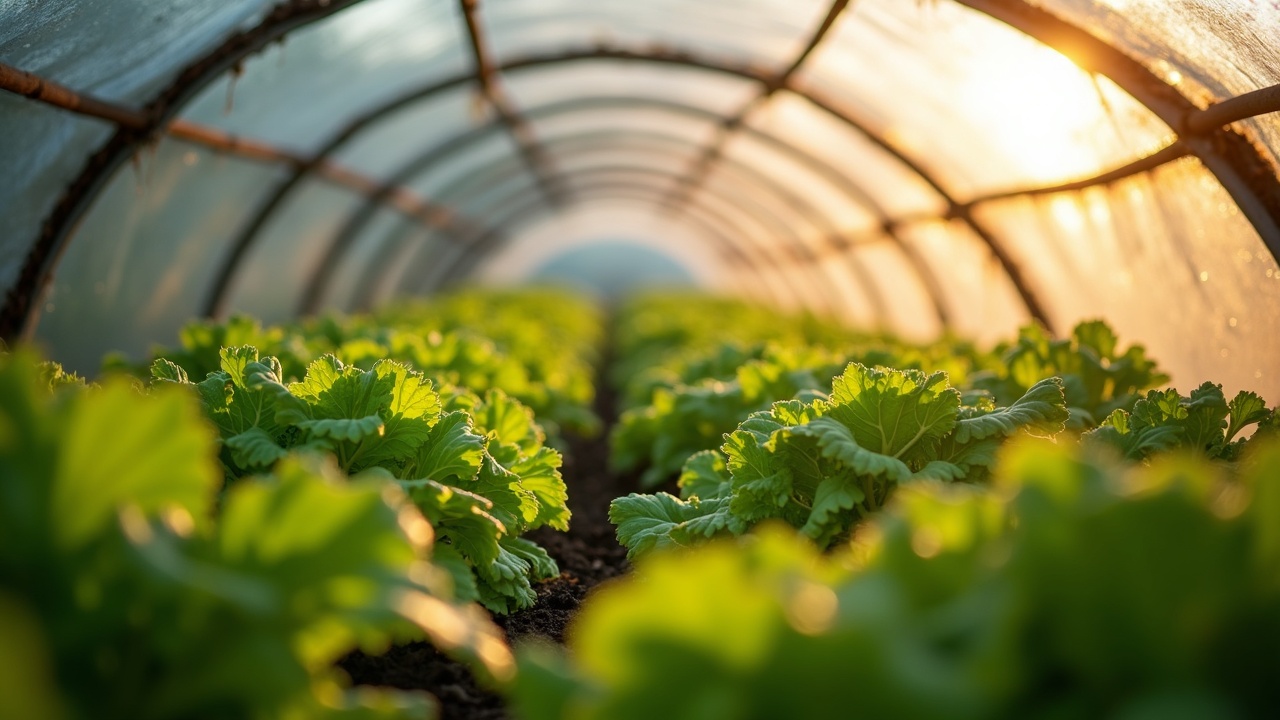
A hoop house is a low-cost greenhouse structure built from bent metal or PVC hoops covered with greenhouse-grade polyethylene film. Unlike glass or polycarbonate greenhouses, a hoop house relies entirely on solar energy for heating and on ventilation for cooling. The investment is minimal compared to any rigid greenhouse structure and the performance, particularly with a double-layer film inflation system, is surprisingly strong.
Basic Hoop House Construction
Standard construction uses galvanized steel conduit or pre-bent greenhouse bows spaced 4–6 feet apart, driven into the ground or attached to a base board. Greenhouse-grade polyethylene film (4-year minimum UV rating; 6 mil thickness) is pulled over the bows and secured at the base with a wiggle wire channel system or by burying the film edge in the soil.
- **Bow material:** 1.5–2 inch galvanized steel conduit bent with a pipe bender (rent from hardware stores); or prefabricated greenhouse bows from suppliers like Farmer's Friend or Bootstrap Farmer
- **Film:** 4-year or 6-year greenhouse poly from Greenhouse Film and similar suppliers; never use hardware store poly which degrades within one season under UV exposure
- **End walls:** Framed with lumber and covered with poly or corrugated polycarbonate; include at least one door per end for ventilation
- **Ventilation:** Roll-up sides using a hand crank or hip board system allow the sidewalls to be raised during warm days; add an exhaust fan at one end for summer operation
Double-Layer Film Systems
The single most cost-effective performance upgrade for any hoop house is adding a second layer of poly film with a small air gap between the two layers, inflated by a continuous small fan. The dead air space between the two layers acts as insulation, approximately doubling the nighttime heat retention of the structure. A double-layer hoop house in Zone 6 maintains temperatures above 28 degrees Fahrenheit on nights down to 10–15 degrees outside, without any supplemental heat. This is sufficient for winter production of hardy greens and root vegetables through the full season.
Season-by-Season Management
| Season | Primary Focus | Best Crops | Key Action | |---|---|---|---| | Late winter / early spring (6 weeks before LFD) | Warm soil; early transplanting | Transplant starts; early brassicas; spinach | Plant cool crops; bring in transplant flats for hardening off | | Spring (last frost through June) | Accelerate warm-season start | Tomatoes, cucumbers, peppers 3–4 weeks ahead of outdoor season | Watch for overheating; ventilate actively; roll up sides when above 65°F | | Summer | Heat exclusion; ventilation | Heat-tolerant crops only; basil; tropical herbs; fall crop establishment in July–Aug | Roll-up sides fully; shade cloth on exterior; exhaust fan on thermostat | | Fall (after first outdoor frost) | Extend warm-season production; transition to cool crops | Extend tomatoes and peppers 4–6 weeks; plant greens for winter | Close at night; ventilate during warm days; water less | | Winter (Zone 6 and 7) | Maintain above 26°F minimum | Hardy greens, spinach, kale, carrots, arugula | Double layer inflated; minimal watering; harvest regularly |
Return on Investment
An unheated double-layer hoop house built for $400 in materials on a 12 by 30 foot footprint in Zone 6 produces an additional 6–8 weeks of spring production and 8–10 weeks of fall and winter production compared to the same bed without the structure. For a market gardener, this alone can generate $3,000–$6,000 in additional annual revenue. For a home grower, it means fresh salad greens and herbs through winter without purchasing from a store.
Scientific and Technical References
**Radiant Cooling and Frost Physics**
- [Snyder RL, de Melo-Abreu JP. 2005. *Frost Protection: Fundamentals, Practice and Economics*, Volume 1. FAO Environment and Natural Resources Service Series No. 10. Rome: FAO.]
- [CITATION NEEDED: radiant cooling plant surface temperature vs. ambient air temperature clear night frost + search: "radiant cooling leaf surface temperature below ambient air clear sky frost damage"]
**High Tunnels and Hoop Houses**
- [USDA NRCS. 2010. Conservation Practice Standard: High Tunnel System (Code 325). *National Engineering Handbook*.]
- [Lamont WJ. 2009. Overview of the use of high tunnels worldwide. *HortTechnology*. 19(1):25–29. doi:10.21273/HORTSCI.44.1.13 [UNVERIFIED — confirm journal and DOI]]
- [Carey EE, Jett L, Lamont WJ, Nennich TT, Orzolek MD, Williams KA. 2009. Horticultural crop production in high tunnels in the United States: a snapshot. *HortTechnology*. 19(1):37–43. doi:10.21273/HORTSCI.44.1.10 [UNVERIFIED — confirm DOI]]
**Double-Layer Film Insulation**
- [CITATION NEEDED: double-layer poly film air inflation nighttime heat retention hoop house + search: "double layer polyethylene film inflation insulation hoop house nighttime temperature retention"]
**Row Cover Performance**
- [Wells OS, Loy JB. 1993. Rowcovers and high tunnels enhance crop production in the northeastern United States. *HortTechnology*. 3(1):92–95. doi:10.21273/HORTTECH.3.1.92 [UNVERIFIED — confirm DOI]]
- [CITATION NEEDED: floating row cover frost protection temperature gain light transmission + search: "floating row cover spunbonded polyester frost protection temperature gain light transmission percentage"]
**Practitioner Reference**
- Coleman, E. (1992). *Four-Season Harvest*. Chelsea Green Publishing. ISBN 978-1890132279.
- Coleman, E. (2009). *The Winter Harvest Handbook*. Chelsea Green Publishing. ISBN 978-1603580816.
- Penn State Extension — High Tunnel Production Systems for the Mid-Atlantic Region. [extension.psu.edu]
- University of Kentucky Cooperative Extension — Row Covers for Season Extension and Pest Management. Publication ID-172.
*"Spring starts when you decide it does."*
Tags
- **topic:** season-extension, hoop-houses, cold-frames, row-cover, greenhouse
- **type:** growing-guide, educational, facility-design
- **audience:** home-growers, market-gardeners
- **plant-species:** general (season extension for all crops)
- **zone:** all-zones, zone-6-focus