Extracting Plants &
Making Products

From solventless heat pressing to supercritical CO2 systems, chromatography, and distillation. Master the art and science of transforming raw botanicals into refined products.

12 Topics 60 min read Includes Safety Guidance
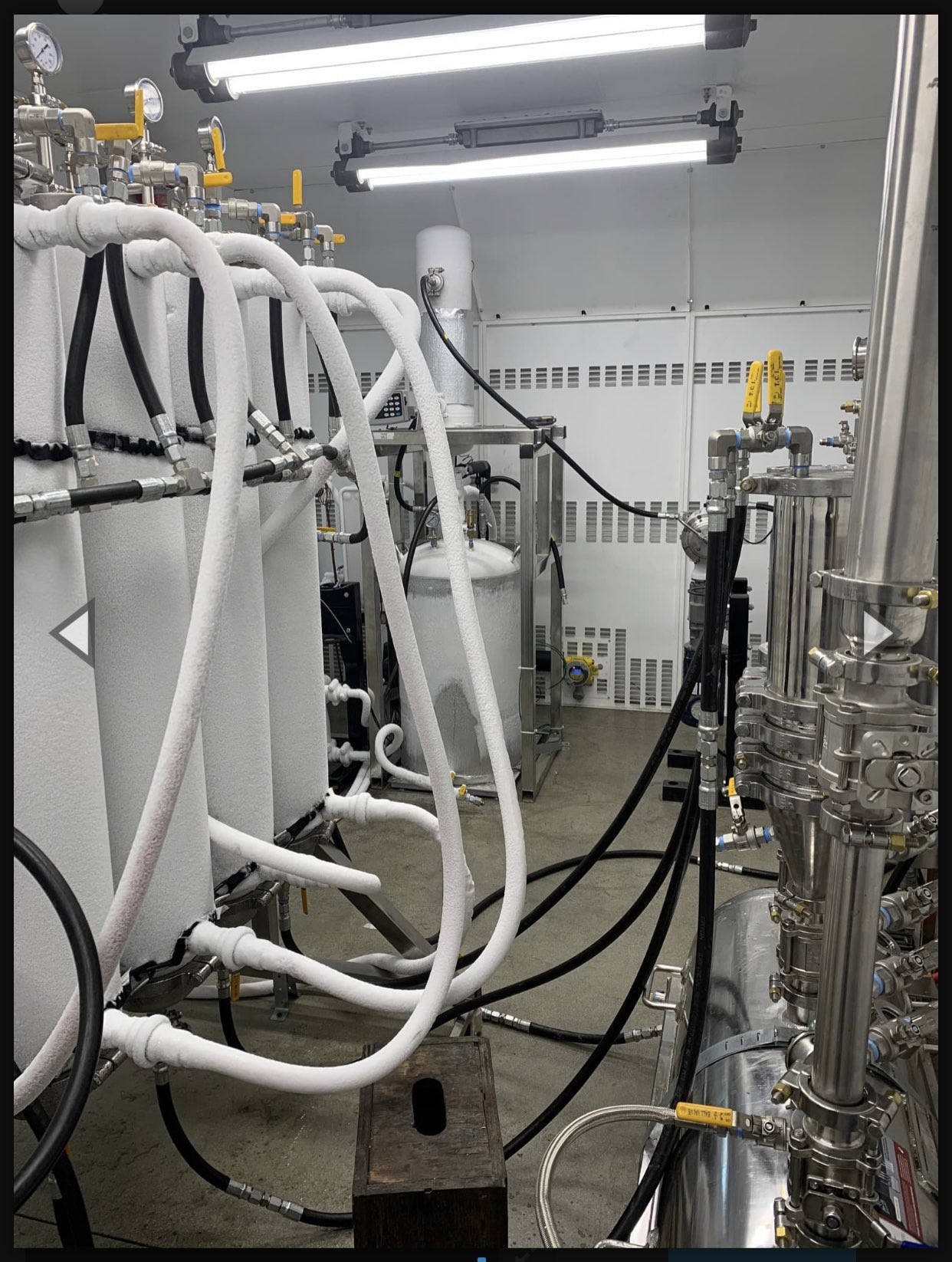
Commercial extraction lab - stainless columns and professional equipment
Section 01

Solventless Extraction

Solventless methods use only mechanical force, heat, or cold to separate desired compounds from plant material. These techniques produce clean extracts without chemical residues and are considered the purest form of extraction.

Heat Press Process
1

Prepare Material

Dried or cured plant material is weighed and placed inside parchment paper or a rosin bag to contain particulates.

2

Set Temperature & Pressure

Plates are heated to 170-220F (77-104C). Lower temps yield better flavor; higher temps yield more volume. Pressure ranges from 500-2000 PSI.

3

Apply Pressure

Material is compressed between heated plates for 30 seconds to 3 minutes. Resinous oils are squeezed out and collected on parchment.

4

Collect & Cure

Extracted rosin is carefully scraped from parchment and optionally cold-cured to improve texture and consistency.

Dry Sifting Process
1

Freeze Material

Plant material is frozen to make trichomes (resin glands) brittle and easier to separate.

2

Agitate Over Screens

Frozen material is gently agitated over fine mesh screens (73-220 micron) to knock trichomes loose.

3

Grade & Collect

Multiple screen sizes sort material by quality. Finer screens produce purer, higher-grade sift.

Equipment Required
Rosin press (manual or hydraulic)
Parchment paper
Micron filter bags
Mesh sifting screens
Collection tools
Temperature controller
Section 02

Water-Based Extractions

Water is the oldest and most accessible solvent for extracting plant compounds. Techniques range from simple teas and decoctions to advanced ice-water separation for isolating trichomes and resin glands.

Ice-Water Extraction (Bubble Hash)
1

Freeze & Submerge

Plant material is combined with ice and cold water in a vessel. The cold makes trichome stalks brittle.

2

Agitate

Material is stirred vigorously for 10-20 minutes. Mechanical agitation breaks trichomes free from plant matter.

3

Filter Through Bags

The slurry is poured through a series of filter bags (220 to 25 micron) to separate trichomes by size and purity.

4

Dry & Cure

Collected material is freeze-dried or air-dried on screens. Proper drying prevents mold and preserves quality.

Key Concepts
  • Hot water extracts water-soluble compounds (alkaloids, polyphenols, tannins)
  • Cold water with agitation physically separates trichomes rather than dissolving them
  • Decoctions (boiling) are used for tough roots, bark, and woody materials
  • Infusions (steeping) are used for delicate leaves and flowers
  • Water temperature affects which compounds are extracted and their stability
Advanced Water Extraction Techniques
  • Freeze Drying: Lyophilization preserves water extracts by sublimating ice under vacuum, retaining potency and extending shelf life without heat degradation
  • Ultrasonication: Ultrasonic waves create cavitation bubbles that rupture cell walls, dramatically increasing extraction efficiency and reducing processing time
  • Acidic Water (Low pH): Adding citric acid or vinegar lowers pH to 2-4, improving extraction of alkaloids like mesembrine, psilocybin, and caffeine which are more soluble in acidic conditions
  • Basic Water (High pH): Raising pH with calcium hydroxide or sodium carbonate improves extraction of certain phenolics, saponins, and pigment compounds
  • DIY Kitchen Methods: Simple water baths, French press, slow cooker infusions, and stovetop decoctions make water extraction accessible to home practitioners
  • Best Plants for Water Extraction: Kanna (mesembrine), kava (kavalactones), tea (catechins/caffeine), chamomile (apigenin), valerian root, passionflower, and most traditional herbal blends
  • Scaling Up: Commercial percolation columns, countercurrent extraction systems, and spray drying enable industrial-scale water-based processing with consistent output
Equipment Required
Bubble bag set (5-8 bags)
5-gallon bucket or vessel
Plenty of ice
Mixing paddle or drill mixer
Drying screens or freeze dryer
Pressing tools & molds
Section 03

Making Ethanol & Ethanol Extraction

Ethanol is one of the most versatile solvents for botanical extraction. It dissolves a wide range of compounds and can be produced through fermentation and distillation. It is also relatively safe to work with compared to other solvents.

Ethanol Extraction Process
1

Chill the Ethanol

Food-grade ethanol (190+ proof) is chilled to -40F or colder. Cold ethanol minimizes chlorophyll and wax extraction.

2

Soak / Wash

Plant material is submerged in cold ethanol for 3-10 minutes. Quick washes produce cleaner extracts; longer soaks yield more compounds.

3

Filter

The solution is strained through multiple filters (coarse to fine) to remove plant solids, waxes, and particulates.

4

Evaporate / Purge

Ethanol is removed via rotary evaporation, falling film, or gentle heat. Reclaimed ethanol can be reused.

5

Winterize (Optional)

Extract is redissolved in ethanol, frozen, and filtered again to remove fats and waxes for a cleaner final product.

Making Ethanol (Fermentation)
  • Ethanol is produced by fermenting sugars with yeast (Saccharomyces cerevisiae)
  • Common substrates: corn mash, sugar cane, grape juice, grain mash, or molasses
  • Fermentation yields a wash of 10-20% ABV, which is then distilled to concentrate
  • Multiple distillation passes can achieve 90-95% purity (190 proof)
  • Molecular sieves or azeotropic distillation reach near-absolute ethanol (200 proof)
  • Legal considerations vary by jurisdiction. Many areas require permits for distillation
Safety Notes
  • Ethanol vapors are highly flammable -- ensure adequate ventilation and avoid open flames
  • Use explosion-proof electrical equipment in areas with ethanol vapor
  • Always use food-grade or pharmaceutical-grade ethanol, never denatured alcohol
  • Cold ethanol can cause frostbite -- use insulated gloves when handling
  • Check local regulations regarding ethanol production and use
Section 04

Pressurized Gas Extraction

Pressurized gas extraction uses CO2 or hydrocarbon solvents (butane, propane) under controlled pressure and temperature to dissolve target compounds. These methods produce highly concentrated, potent extracts.

Supercritical CO2 Extraction
1

Pressurize CO2

CO2 is heated and pressurized above its critical point (87.9F / 1,071 PSI) where it behaves as both liquid and gas.

2

Pass Through Material

Supercritical CO2 flows through packed plant material in an extraction vessel, dissolving target compounds.

3

Separate

Pressure is reduced in a separator vessel. CO2 returns to gas, dropping dissolved compounds into a collection vessel.

4

Recycle & Refine

CO2 is recaptured and recycled. Extract may be further refined via winterization or distillation.

Hydrocarbon Extraction (BHO)
  • Uses butane, propane, or blends as solvents at low pressure and temperature
  • Highly efficient at dissolving terpenes and lipophilic compounds
  • Produces shatter, wax, budder, and live resin depending on post-processing
  • Requires closed-loop systems with certified safety equipment
  • Residual solvent testing is critical to ensure product safety
  • CO2 is non-toxic and leaves no residue; hydrocarbons require thorough purging
Critical Safety Requirements
  • Hydrocarbon extraction must only be performed in certified, ventilated facilities
  • Open blasting (non-closed-loop) is extremely dangerous and often illegal
  • Butane and propane are highly flammable and heavier than air -- they pool at floor level
  • CO2 systems operate at very high pressures -- equipment must be rated and inspected
  • All gas extraction requires gas detection sensors and emergency shutoff systems
  • Only trained technicians should operate pressurized extraction equipment
Systems & Industry Applications
  • Small-Scale Closed-Loop: Tabletop BHO systems with 1-2 lb capacity allow home-scale hydrocarbon extraction with passive or active solvent recovery in a sealed circuit
  • Industrial Supercritical CO2: Large-scale systems with 10-100L extraction vessels operate at 1,500-5,000 PSI with programmable pressure and temperature profiles for selective compound targeting
  • Inline Dewaxing: Integrated dewaxing columns chill the extract stream mid-process, precipitating waxes and lipids before they reach the collection vessel, eliminating a post-processing step
  • Passive vs Active Recovery: Passive recovery uses temperature differentials to move solvent; active recovery uses pumps for faster throughput and higher reclaim rates (95%+ recovery)
  • Industry Uses: Supplement manufacturing (turmeric curcumin, ashwagandha), cannabis concentrates, essential oil production, decaffeination of coffee and tea, food-grade flavor and fragrance extraction, and pharmaceutical isolates
Section 05

Chromatography

Chromatography separates mixtures into individual components based on how they interact with a stationary phase and a mobile phase. It is essential for isolating specific compounds and removing impurities from crude extracts.

Column Chromatography Process
1

Pack the Column

A glass column is packed with stationary phase media (silica gel, alumina, or C18 bonded silica) and conditioned with solvent.

2

Load the Extract

Crude extract is dissolved in a minimal amount of solvent and carefully loaded onto the top of the column.

3

Elute with Gradient

Mobile phase solvents are passed through the column with gradually changing polarity, separating compounds by affinity.

4

Collect Fractions

Output is collected in sequential fractions. Each fraction is tested (TLC, HPLC) to identify target compounds.

5

Concentrate & Verify

Target fractions are combined, solvent is evaporated, and purity is verified via analytical testing.

Types of Chromatography
  • Column (Flash): Gravity or pressurized flow. Common for initial purification of crude extracts
  • HPLC: High-Performance Liquid Chromatography. Precise analytical and preparative separations
  • TLC: Thin-Layer Chromatography. Quick screening to monitor separation progress
  • CPC/CCC: Centrifugal Partition / Counter-Current. Liquid-liquid separation without solid media
  • GC: Gas Chromatography. Used for volatile compound analysis and terpene profiling
Equipment Required
Glass columns (various sizes)
Silica gel or alumina media
HPLC-grade solvents
Fraction collector
UV detector / TLC plates
Rotary evaporator
Practical Applications & DIY
  • Color Remediation (CRC): Passing crude extract through layered filter media (activated charcoal, bentonite clay, silica, diatomaceous earth) removes chlorophyll, carotenoids, and dark pigments to produce light, clean concentrates
  • Water Purification: Activated charcoal columns adsorb pesticides, heavy metals, chlorine, and organic pollutants from water -- the same principle used in municipal water treatment and home filtration
  • DIY Charcoal Columns: A glass column packed with food-grade activated charcoal can remove color and off-flavors from homemade tinctures and extracts at minimal cost
  • Media Comparison: Activated charcoal excels at broad-spectrum adsorption; silica gel separates by polarity; alumina targets acidic or basic compounds; molecular sieves filter by molecular size for precise separations
  • Flash Chromatography: Pressurized columns (5-20 PSI air or nitrogen) dramatically speed up preparative separation, processing in minutes what gravity columns take hours to complete
Section 06

Distillation

Distillation separates compounds based on differences in their boiling points. In botanical extraction, it is used to purify crude extracts into highly concentrated distillates and to produce essential oils through steam distillation.

Short-Path Distillation
1

Decarboxylate & Prepare

Crude extract is decarboxylated if needed and loaded into the boiling flask of the short-path apparatus.

2

Apply Vacuum & Heat

Deep vacuum (50-500 micron) lowers boiling points dramatically. Heat is gradually increased to selectively vaporize target compounds.

3

Condense & Collect

Vapors travel a short path to a chilled condenser, liquefying and dripping into collection flasks separated by fraction.

4

Second Pass (Optional)

A second distillation pass further refines the distillate, achieving purities of 90-99% for target compounds.

Distillation Methods
  • Short-Path: Compact, high-vacuum system for purifying heat-sensitive compounds
  • Wiped-Film: Continuous feed system with thin film for high throughput and gentle processing
  • Steam Distillation: Steam passes through plant material to carry volatile essential oils
  • Fractional: Column with packing for separating compounds with close boiling points
  • Rotary Evaporation: Not true distillation but used to gently remove solvents under vacuum
Safety Notes
  • Hot glassware and heated mantles present burn hazards -- use heat-resistant gloves
  • Vacuum systems create implosion risk if glassware is cracked or stressed
  • Some distillation temperatures can degrade or decompose compounds, releasing fumes
  • Ensure all glassware joints are properly greased and secured before applying vacuum
  • Never leave a running distillation unattended
Advanced Distillation Techniques
  • Short-Path Vacuum Distillation: By reducing pressure to 50-500 micron, boiling points drop by hundreds of degrees, allowing heat-sensitive botanical compounds to be purified at gentle temperatures (130-220C mantle) without thermal degradation
  • Wiped Film / Thin Film: A rotating wiper blade spreads extract into an ultra-thin film on a heated cylinder wall, enabling continuous feed processing with residence times under 10 seconds -- ideal for high-throughput commercial operations
  • Fractional Distillation: A packed or plate column between the boiling flask and condenser provides multiple theoretical plates of separation, allowing precise isolation of compound groups with close boiling points (terpene fractions, cannabinoid cuts)
  • Temperature-Vacuum Relationship: Every compound has a characteristic boiling point that shifts predictably under vacuum. Operators use vacuum depth to dial in exact separation temperatures -- deeper vacuum means lower heat needed, reducing decomposition risk
Section 07

Crystallization

Crystallization isolates pure compounds by forming solid crystals from a concentrated solution. It is the gold standard for achieving maximum purity and is used to isolate specific alkaloids, flavonoids, and other target molecules.

Crystallization Process
1

Dissolve in Hot Solvent

Purified extract is dissolved in a minimum of hot solvent (pentane, heptane, or ethanol/hexane blends) to create a saturated solution.

2

Slow Cooling

The solution is cooled gradually and evenly. Slow cooling promotes the growth of large, pure crystals. Rapid cooling yields smaller, less pure crystals.

3

Seed (Optional)

A small amount of pure target compound can be added as a seed crystal to initiate and direct crystal growth.

4

Filter & Wash

Crystals are collected by vacuum filtration and washed with cold solvent to remove impurities trapped on the surface.

5

Dry & Verify

Crystals are dried under vacuum and analyzed (melting point, HPLC) to confirm identity and purity (>95%).

Key Principles
  • Solubility decreases as temperature drops, forcing target compounds out of solution as crystals
  • Choosing the right solvent system is critical -- the compound must be soluble when hot but insoluble when cold
  • Recrystallization (repeating the process) further increases purity with each cycle
  • Impurities remain dissolved in the mother liquor (the liquid left after crystals form)
  • Crystal polymorphism: some compounds can form different crystal structures with different properties
Equipment Required
Jacketed reactor vessel
Vacuum filtration setup
HPLC-grade solvents
Temperature controller
Buchner funnel & flask
Analytical balance
Section 08

Solvent Reclaiming with Equipment

Solvent recovery is essential for cost efficiency, environmental responsibility, and operational sustainability. Reclaiming solvents reduces waste, lowers material costs, and minimizes environmental impact.

Solvent Recovery Workflow
1

Collect Spent Solvent

Used solvent containing dissolved compounds is collected from extraction and filtration processes.

2

Load Recovery System

Spent solvent is fed into a rotary evaporator, falling film evaporator, or dedicated solvent recovery unit.

3

Evaporate & Condense

Heat and/or vacuum vaporize the solvent. Vapors are condensed back to liquid in a chilled condenser and collected.

4

Test & Reuse

Recovered solvent is tested for purity and contamination. Clean solvent is returned to the extraction process. Recovery rates of 90-95% are typical.

Recovery Equipment
  • Rotary Evaporator (Rotovap): Standard lab equipment for gentle solvent removal under vacuum. 1-50L capacity
  • Falling Film Evaporator: Continuous-flow, high-throughput system for large-scale operations
  • Closed-Loop Recovery: Built into hydrocarbon extraction systems, automatically recovers butane/propane
  • Solvent Recovery Tank: Heated tank with condenser for batch recovery of ethanol and other solvents
  • Chiller Units: Provide cold coolant to condensers for efficient vapor-to-liquid conversion
Safety & Environmental Notes
  • Solvent recovery reduces hazardous waste disposal requirements
  • Ensure recovery systems are properly grounded to prevent static discharge
  • Monitor recovered solvent quality -- contaminated solvent can compromise product purity
  • Follow local environmental regulations for solvent storage and disposal
  • Maintain recovery equipment regularly to prevent leaks and ensure efficiency
Section 09

Carrier & Delivery Methods

Once compounds are extracted and purified, they need to be formulated into products that deliver the active ingredients effectively. The carrier system determines bioavailability, onset time, and user experience.

Water-Soluble Formulations

Lipophilic extracts are made water-compatible through nanoemulsion or encapsulation technology. This dramatically improves absorption rate and bioavailability (up to 4-5x improvement).

Nanoemulsions Liposomes Cyclodextrin complexes Drink mixes

Oil-Based Carriers

Extracts are dissolved in carrier oils that serve as both a delivery vehicle and a bioavailability enhancer. Fat-soluble compounds are naturally compatible with oil carriers.

MCT oil Hemp seed oil Olive oil Tinctures Topicals

Capsules & Solid Forms

Dried or concentrated extracts are encapsulated for precise dosing, shelf stability, and convenient consumption. Enteric coatings can target release to specific areas of the GI tract.

Gelatin capsules Veggie caps Tablets Softgels Gummies
Formulation Considerations
  • Bioavailability: How much of the active compound actually reaches the bloodstream. Varies significantly by delivery method
  • Onset Time: Sublingual tinctures act in 15-30 min; capsules in 45-90 min; nanoemulsions in 10-20 min
  • Stability: Light, heat, and oxygen degrade many botanical compounds. Proper packaging extends shelf life
  • Taste Masking: Many botanical extracts are bitter. Capsules, gummies, and flavored formulations improve palatability
  • Dose Accuracy: Capsules and measured tincture droppers provide the most consistent dosing
Production Equipment
High-shear homogenizer
Capsule filling machine
Tincture bottling line
Gummy molds & depositor
Particle size analyzer
Packaging & labeling
Section 10

Plant Oils for Extraction & Infusion

Carrier oils produced from seeds and nuts serve as both a product base and an extraction medium for nonpolar botanical compounds. From cold-pressed MCT to black seed oil, these lipid carriers dissolve fat-soluble actives and deliver them in a bioavailable, shelf-stable form.

Oil Infusion Process
1

Select Carrier Oil

Choose based on end use: MCT oil (coconut fractionated) for fast absorption and neutral flavor, blackseed oil for its own bioactive compounds, olive oil for culinary products, or hemp seed oil for nutritional profile.

2

Decarboxylate Material (If Needed)

For compounds requiring heat activation (such as cannabinoid acids), bake plant material at 220-250F for 30-45 minutes to convert precursor molecules into their active forms before infusion.

3

Warm Infusion

Combine plant material with oil at 130-180F for 2-6 hours using a double boiler, slow cooker, or precision heating mantle. Low heat preserves terpenes and prevents degradation while dissolving lipophilic compounds.

4

Cold Maceration (Alternative)

For delicate aromatics and heat-sensitive compounds, submerge material in oil at room temperature for 4-8 weeks in a dark container, shaking daily. Slower but gentler extraction.

5

Filter & Bottle

Strain through cheesecloth, then fine-filter through coffee filters or lab filter paper. Store in dark glass bottles with minimal headspace to prevent oxidation.

Producing Plant Oils
  • Cold Pressing: Seeds or nuts are mechanically squeezed at temperatures below 120F, preserving heat-sensitive fatty acids and antioxidants. Lower yield but highest nutritional quality
  • Expeller Pressing: A screw press generates higher friction and heat (up to 210F), producing greater oil yield from tougher seeds like hemp, sunflower, and flax at the cost of some nutrient loss
  • Solvent Extraction of Oils: Food-grade hexane dissolves oils from seed meal after pressing, maximizing yield. The hexane is then fully evaporated and recovered, leaving pure oil behind
  • MCT Oil: Fractionated coconut oil isolates medium-chain triglycerides (C8/C10) through steam hydrolysis and fractional distillation -- fast-absorbing, shelf-stable, and flavor-neutral
  • Blackseed Oil (Nigella sativa): Cold-pressed from black cumin seeds, containing thymoquinone and other bioactive compounds with documented antioxidant and anti-inflammatory properties
  • Hemp Seed Oil: Rich in omega-3 and omega-6 fatty acids in an optimal ratio, cold-pressed from hulled hemp seeds. Distinct from hemp extract -- contains no cannabinoids
Applications
  • Tinctures & Sublingual Oils: Oil-based extracts taken under the tongue for rapid absorption through mucous membranes, bypassing first-pass metabolism
  • Topicals & Salves: Infused oils blended with beeswax, shea butter, or other emollients for transdermal delivery to localized areas
  • Edibles & Cooking: Infused olive oil or coconut oil used directly in recipes, providing consistent dosing when properly tested and labeled
Equipment Required
Manual or hydraulic oil press
Heating mantle or double boiler
Precision thermometer
Filtration setup (Buchner or gravity)
Dark glass storage bottles
Cheesecloth & filter papers
Section 11

Aromatics & Steam Distillation

Steam distillation is one of humanity's oldest extraction techniques, dating back to ancient Mesopotamia and refined by Persian polymath Avicenna around 1000 CE. It remains the primary method for producing essential oils from aromatic plants -- capturing volatile compounds without chemical solvents.

Steam Distillation Process
1

Harvest & Prepare Plant Material

Aromatic herbs are harvested at peak oil content (typically mid-morning after dew evaporates). Material is loosely chopped or bruised to expose oil glands without compacting the bed.

2

Load the Still

Plant material is packed loosely into the still body (copper or stainless steel) above a water reservoir or separate steam generator. Even packing ensures uniform steam distribution.

3

Generate Steam

Water is heated to produce steam that rises through the plant bed. The steam ruptures oil glands and carries volatile aromatic compounds upward as a vapor mixture.

4

Condense

The steam-oil vapor passes through a coiled condenser cooled by cold water, converting the vapor back into a liquid mixture of water and essential oil.

5

Separate & Collect

The liquid drains into a Florence flask or separating funnel where oil and water naturally separate by density. Essential oil is drawn off the top (or bottom for heavy oils). The remaining hydrosol (floral water) is itself a valuable co-product.

Growing Aromatic Plants
  • Lavender: Hardy perennial, prefers full sun and well-drained alkaline soil. Harvest when 50% of flower spikes have opened. Yields 1-3% essential oil by weight
  • Rosemary: Drought-tolerant evergreen shrub. Trim actively growing tips for highest oil concentration. Yields 0.5-2.5% essential oil
  • Peppermint: Aggressive spreader that thrives in moist soil with partial shade. Harvest just before flowering for peak menthol content. Yields 0.5-4%
  • Lemongrass: Tropical grass that grows fast in warm climates. Cut stalks at 6-8 inches from the ground. Yields 0.2-0.5% citral-rich oil
  • Eucalyptus: Fast-growing trees with high cineole content. Young leaf growth produces the most oil. Yields 1-3% essential oil
  • Ancient Origins: Archaeological evidence of distillation apparatus in Mesopotamia dates to 3500 BCE. Avicenna's 11th-century refinement of the coiled condenser made efficient essential oil production practical
DIY vs Commercial Scale
  • Home Setup: A 2-10 liter copper or stainless still, a stovetop or propane burner, a coiled condenser with running tap water, and a glass separating funnel -- total investment under $300
  • Commercial Hydrodistillation: Industrial stills hold 100-2,000+ liters of plant material, use dedicated steam boilers, and process hundreds of pounds per batch with automated temperature control
  • Oil Yields: Most aromatic plants yield 0.5-3% essential oil by weight of fresh material. Rose petals are exceptionally low at 0.02-0.05%, making rose oil one of the most expensive essential oils
  • Quality Testing: GC-MS analysis verifies chemical composition and purity. Specific gravity, refractive index, and optical rotation are standard quality benchmarks
  • Storage: Essential oils degrade with light, heat, and oxygen. Store in amber glass bottles with tight caps in a cool, dark location. Most oils remain stable for 1-3 years when stored properly
Equipment Required
Copper or stainless steel still
Coiled condenser with water supply
Florence flask or separating funnel
Glass collection vessels
Heat source (burner or mantle)
Amber glass storage bottles
Section 12

Making Solvents from Crops

Growing your own feedstock and fermenting it into high-proof ethanol closes the loop on botanical extraction -- producing the very solvent you use to process plants. Crop-derived ethanol also serves as a disinfectant, sanitizer, and fuel, making it one of the most versatile outputs of a self-sufficient operation.

Crop-to-Solvent Process
1

Grow & Harvest Feedstock

Corn, sugar cane, sorghum, or switchgrass are cultivated as sugar/starch sources. Sugar cane and sorghum offer the simplest conversion; corn and grain require an extra mashing step to convert starch to sugar.

2

Prepare the Mash

Grain is milled and cooked with water and enzymes (alpha-amylase, glucoamylase) to break starch into fermentable sugars. Sugar cane juice or molasses can skip this step and go directly to fermentation.

3

Fermentation

Yeast (typically Saccharomyces cerevisiae, turbo yeast, or distiller's yeast) is pitched into the sugar wash at 70-90F. Over 3-7 days, yeast converts sugars to ethanol and CO2, producing a wash of 10-20% ABV.

4

Distill to High Proof

The fermented wash is distilled using a pot still (simpler, lower proof per pass) or a reflux column still (achieves 190+ proof in a single run). Multiple passes through a pot still can reach 150-170 proof.

5

Dehydrate to Near-Absolute (Optional)

Standard distillation hits a 95.6% azeotrope ceiling (191 proof). To reach 200 proof (anhydrous ethanol), pass through molecular sieves (3A zeolite beads) that adsorb the remaining water molecules.

Feedstock & Fermentation Details
  • Corn: The most common feedstock in the US. Field corn yields approximately 2.8 gallons of ethanol per bushel after enzymatic conversion of starch to glucose
  • Sugar Cane & Sorghum: Juice is pressed directly from stalks -- no enzyme step needed. Sugar cane yields about 20 gallons of ethanol per ton of cane in tropical climates
  • Switchgrass & Cellulosic: Requires additional pretreatment (acid hydrolysis or cellulase enzymes) to break cellulose into sugars. Lower yield but uses marginal land and crop waste
  • Yeast Strains: Turbo yeasts tolerate higher alcohol concentrations (up to 20% ABV) and ferment faster than bread yeast. Temperature control is critical -- too hot kills yeast, too cold stalls fermentation
  • Pot Still vs Reflux Column: A pot still is simpler to build and operate but yields 50-70% ABV per run. A reflux column with copper packing achieves 90-95%+ in a single pass, making it far more efficient for solvent production
Dual-Use Applications
  • Extraction Solvent: High-proof ethanol (190-200 proof) is the workhorse solvent for botanical extraction -- dissolving cannabinoids, alkaloids, terpenes, and flavonoids efficiently
  • Disinfectant & Sanitizer: 60-80% ethanol solutions are effective broad-spectrum disinfectants for lab surfaces, equipment, and hands -- meeting CDC guidelines for pathogen elimination
  • Fuel & Energy: Ethanol can fuel flex-fuel generators, stoves, and vehicles, providing energy independence alongside extraction capability
Legal & Safety Considerations
  • In the US, producing ethanol via distillation requires a federal fuel alcohol permit (TTB) or a distilled spirits permit -- even for personal use. State laws add additional requirements
  • Fermentation alone (making wine, beer, or wash) is legal for personal use in most jurisdictions without a permit
  • Ethanol vapors are extremely flammable -- distillation must be conducted outdoors or in well-ventilated, spark-free environments
  • Never use denatured alcohol or methanol for botanical extraction -- these contain toxic additives that cannot be safely removed
  • Test distillate proof with a calibrated hydrometer or alcoholmeter before use as an extraction solvent
Equipment Required
Fermentation vessels (5-55 gal)
Reflux column still (copper)
Hydrometer / alcoholmeter
Molecular sieves (3A zeolite)
Grain mill or press
Temperature-controlled fermenter

Continue Your Learning Journey

Explore our other classrooms to understand the complete botanical process from growing to the effects on the body.